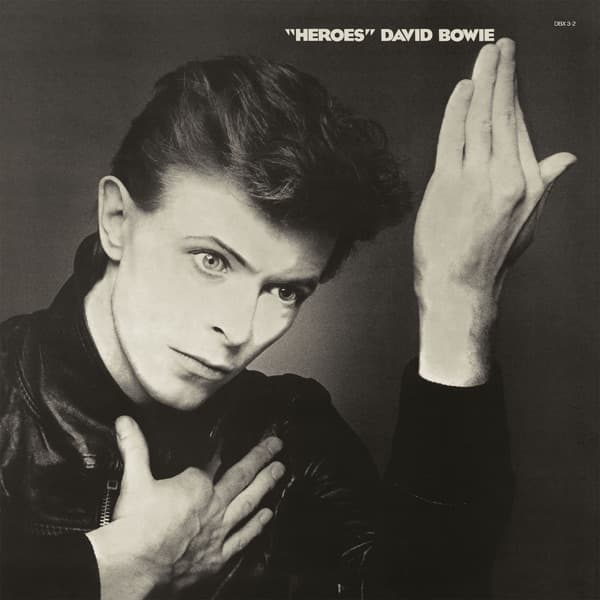


The eyes find you first. In stark, high-contrast black and white, David Bowie stares straight out from the cover of "Heroes", his pale face floating against a soft grey ground, one eyebrow lifted, mouth set somewhere between challenge and trance. Then your gaze travels to the hands. One presses flat against his chest over a black leather jacket; the other rises stiffly into the upper right of the frame, fingers locked together, palm turned out like a half-shutter against the light. It is a pose that feels carved rather than caught.
That angular geometry was no accident of the moment. Bowie built the gesture from his fascination with the German Expressionist painter Erich Heckel and the Die Brücke movement, and the picture most often named as the source is Heckel's 'Roquairol', whose theatrical, jutting hand and haunted stare echo straight through this sleeve. Importantly, this is a photograph, not a painting reproduced: the Expressionist work was the spark for the pose, not the image on the cover.
What makes the result more remarkable is how little planning went into the shoot. The photographer was Masayoshi Sukita, and the session happened in April 1977 in a small studio in the Harajuku district of Tokyo, borrowed at short notice from a photographer friend. Bowie was in the city with Iggy Pop, the two of them there to promote Iggy's album The Idiot. There was no time to map it all out. The drama you see was conjured fast, on instinct, in a rented room.
That same Heckel influence had already surfaced on the cover of The Idiot, the Iggy Pop record Bowie produced, and the two sleeves share a stiff, stagey, sculptural language of the body. At the same Tokyo session Sukita also turned his lens on Iggy himself. So the frame that became "Heroes" belongs to a small constellation of images from that trip, all speaking the same angular dialect.
The choice of which frame to use came later, and almost casually. After the session Sukita selected and printed about ten of his favourites and sent them on to Bowie. Months passed. Then Bowie asked to use one for his upcoming album, and the shot they both liked best became the cover. The print's grain, its deep blacks swallowing the leather jacket, its near-white skin: all of it suits a record made in a divided city.
Because the music behind this face came out of West Berlin. "Heroes" was recorded at Hansa Studio, shaped by the tension of the split city and by Bowie's work with Brian Eno and Tony Visconti. The cool, withheld emotion of the portrait, that frozen gesture and unreadable stare, reads like a visual rhyme for the album's mood, even if it was shot half a world away in Tokyo.
The typography keeps everything spare. Across the top, in clean white capitals, the title sits inside its own quotation marks, "HEROES", with DAVID BOWIE beside it and a small catalogue code, DBX 3-2, tucked into the corner, the release carrying RCA Records. Nothing competes with the face. The lettering simply labels the apparition and steps back.
The sleeve has kept pulling people back. In 2013, the cover for Bowie's album The Next Day took this very image as its base, layering a plain white square over the famous face, an act that only worked because so many already knew exactly what was being covered. That is the strange power of one fast frame from a borrowed Harajuku studio: a hand held up like a screen, a stare you cannot quite hold, an image that refuses to fade.