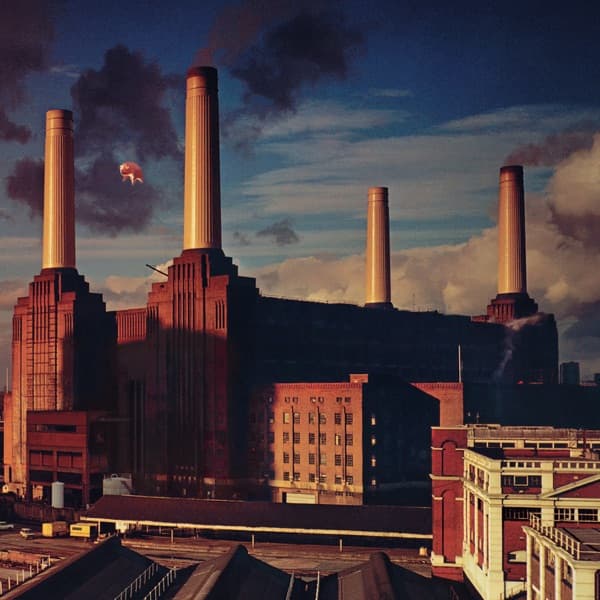
The first thing your eye finds is not the pig. It is the four cream chimneys of Battersea Power Station, rising like enormous fluted candles above a dark brick hulk, their tops catching a low golden light while the base of the building sinks into shadow. Only after that does the small pink shape register: a bloated flying pig, drifting between the two left-hand chimneys, absurd and quietly menacing against a bruised blue sky stacked with dark clouds. That single incongruity is the whole story of Animals, and getting it onto film nearly closed an airport.
The idea belonged to bassist Roger Waters, who lived near Clapham Common and drove past the Art Deco power station so often that it lodged in his imagination. He picked this exact view of the building and imagined a giant pig floating between its chimneys. It was his concept that made the final cover.
Since 1968's A Saucerful of Secrets, the band had turned for artwork to Storm Thorgerson and Aubrey Powell of the design firm Hipgnosis, and they came back again here. Thorgerson, though, was not sold on the pig. He thought it too obvious, calling it 'a tad silly, not to mention low on mystery and meaning.' His own rejected pitch was stranger and more disturbing: a child opening a door to discover his parents in the middle of lovemaking, an image meant to tap the album's themes of anger and the 'animal' side of human behaviour. Waters' pig won.
To build it, the band commissioned the German company Ballon Fabrik, former Zeppelin builders, along with Australian artist Jeffrey Shaw. Together they made a 12-metre helium pig, 40 feet of inflatable pink, and named it Algie. A marksman was hired to stand by and shoot the balloon down should it slip its ropes. The precaution turned out to be exactly the right instinct.
On the first day, the sky delivered the mood you see on the cover: heavy, cloud-piled, ominous. On the second day, manager Steve O'Rourke forgot to re-book the marksman. On 3 December 1976, with no one to bring it down, Algie tore loose from its moorings and rose into the sky over London. It drifted straight into the flight path of Heathrow Airport. Flights were grounded. Pilots reported a pig in the air. Later that night Powell got a phone call from a farmer in Kent: Algie had come down in his field and was frightening his cows.
A third attempt was made, gunmen reinstated this time, and it produced a clean shot of the pig aloft. But the weather betrayed them in a different way: the sky that day was too sunny, bright and blue and wrong for a record this bleak. So Powell took the good pig from the sunny third day and superimposed it onto the darker, cloudier photograph shot on the first day. What looks like a single moment on the cover is a splice of two.
Look again at the image and you can feel that stitched-together quality working in the record's favour. The station's chimneys glow warm at their tips, but the sky above them is turning to storm, and the pig sits in that in-between light like something that does not belong. Below, London sprawls in red brick: warehouses, an office block dotted with small lit and unlit windows, low industrial roofs and a rail yard fading into haze at the horizon. It is a portrait of a working city with a monster balloon hanging over it, and nobody in the picture is looking up.
When the album arrived on 21 January 1977, released by Harvest Records in the UK and Columbia Records in the US, not everyone was moved by its vision. Rolling Stone's Frank Rose attacked its 'bleak defeatism,' arguing the band's message had curdled into something pointless and tedious. The public disagreed with the pen. The record reached No. 2 in the UK and No. 3 in the US and went on to sell four million copies in America.
Algie itself outlived the shoot and became a piece of history in its own right. In 2011 the band recreated the cover to announce a reissue of the album, floating a pig over Battersea again. The balloon eventually passed to a company called Air Artists and was even listed for auction in 2015, before the band stepped in and brought it back into the fold.
What lingers, in the end, is the discipline of the image: no logo shouting from the sky, no band photo, no title splashed across the front, just a real building the bassist drove past every day and one impossible pink intruder floating where a plane should be. The mystery Thorgerson feared it lacked turns out to live in the gap between the warm-lit chimneys and the darkening clouds, in a pig that grounded Heathrow and scared a farmer's cows, now hanging silent and permanent over a city that never noticed it pass.