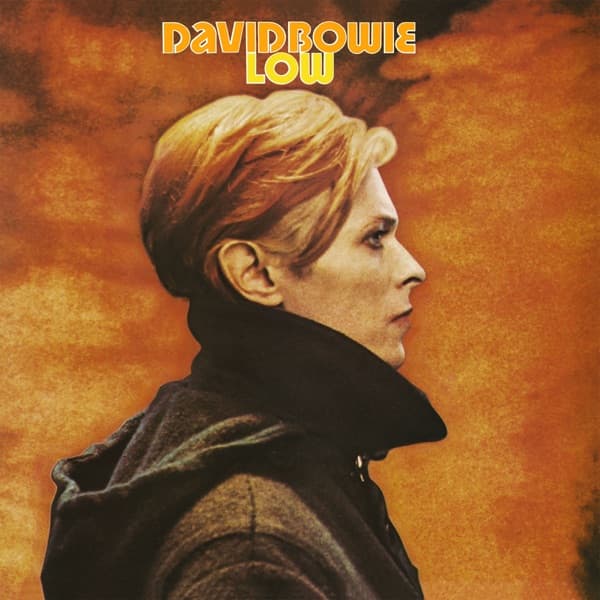

The cover of Low is simpler, and better documented, than the mythology that has accumulated around it. David Bowie appears in profile against a saturated orange field, looking less like a rock star posing for a new album than the alien Thomas Jerome Newton he had played in Nicolas Roeg's The Man Who Fell to Earth. That is because the image belongs to the visual world of the film. Steve Schapiro's photography and artwork for the American promotion of The Man Who Fell to Earth supplied the material that became the Low sleeve.
Bowie had considered other artwork before arriving there. An official retrospective from his estate notes that he sketched ideas while the album still carried the working title New Music: Night And Day. The eventual title change came late enough that contemporary release listings were still using the earlier name. Schapiro had already produced a poster and advertisement for the U.S. release of The Man Who Fell to Earth using a still of Bowie as Newton, and that visual route became the basis of the album artwork.
The final choice also contained a joke that was easy to miss. Bowie is shown in profile; the record is called Low. Bowie himself pointed out the connection shortly after release, noting that the album showed his profile while he was keeping a low profile on the record. The sleeve therefore works simultaneously as a film image, a portrait and a visual pun. None of those layers requires an invented story about elaborate darkroom manipulation or a secret instruction to visualize Bowie's psychological state.
The production history suggests that the package came together quickly. The back cover used a sticker for the track listing rather than a fully integrated printed treatment, and Bowie's official site has described the release as a rush job. RCA was hesitant about the album itself and reportedly wanted more conventional material, but the surviving documentation does not establish that the label objected specifically to the front-cover design. That distinction matters: the music's difficult release history should not be turned into a separate, unsupported controversy about the sleeve.
Schapiro's role is also clearer than the old 'uncredited' label suggested. Bowie's official album page credits Steve Schapiro with photography, while the estate's anniversary history says Schapiro produced the artwork that became Low from his earlier U.S. film advertising. The exact division between photographer, poster maker and record-sleeve production is less important than giving the known creator credit instead of treating the image as anonymous.
Visually, the strength of Low comes from reduction. Bowie's sharply outlined profile occupies one side of the square while the orange field does much of the compositional work. There is no need for a complicated symbolic program: the face is familiar, the Newton character introduces the film connection, and the title makes the profile itself into wordplay. The absence of front-cover typography lets those pieces operate without explanation.
Seen in that context, Low belongs to a recurring Bowie practice of recycling and recontextualizing images across media. A film-promotion image becomes an album cover; a character becomes a portrait of the musician who played him; a last-minute title turns an existing profile into a joke. The documented story is more precise than the dramatic legends that grew around the cover, and it makes the sleeve's apparent simplicity feel deliberate rather than mysterious.