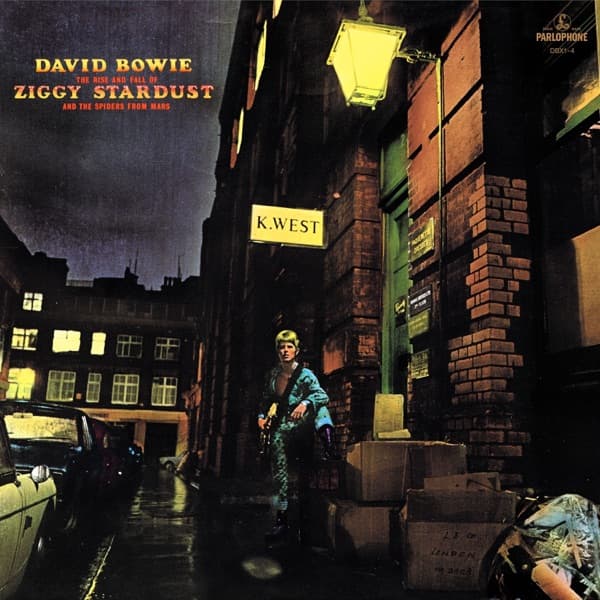
The eye lands first on the lone figure standing in a pool of yellow light, electric guitar slung against his hip, one knee raised in mid-stride against a rough brick wall. Everything around him is wet and dark — slick cobbles throwing back the glow of a hanging street lamp, parked cars receding into blue-black shadow, a scatter of discarded cardboard boxes near his feet. Above his head, almost like a halo or a coded instruction, glows a small white sign reading K. WEST.
This is The Rise and Fall of Ziggy Stardust and the Spiders from Mars, released on 16 June 1972 through RCA Records, and the scene is Heddon Street, a cul-de-sac off Regent Street in London. Photographer Brian Ward, who kept a first-floor studio at number 29, shot the picture on the cold, damp night of 13 January 1972 using Royal-X-Pan black-and-white film. David Bowie had asked him for a location like a 'Brooklyn alley scene,' somewhere he could appear alone, an exotic stranger dropped into an ordinary street.
Ward understood the assignment. 'He was playing on this Man from Mars thing,' he recalled of Bowie. 'He wanted to come over like a real stranger, like a science fiction movie.' That night fifty-four photographs were taken — Bowie under the street light, in and around a nearby phone box, posed in front of number 23. The miserable weather turned out to be a gift: the wet road reflected every light source, and with no one else in frame, Bowie became the single exotic focus of the whole image.
The guitar he cradles is a Gibson Les Paul, and it wasn't his — it belonged to Arnold Corns guitarist Mark Pritchett, the same instrument heard on the Corns recordings of 'Moonage Daydream' and 'Hang On to Yourself.' But the photograph as Ward shot it was monochrome; the otherworldly color you see is entirely the work of illustrator Terry Pastor of the Main Artery design studio in Covent Garden. Given a single frame to work from — recommended to Bowie by George Underwood — Pastor hand-tinted the grey night into something alien, airbrushed the red-and-yellow Letraset titles into the upper-left sky, and inset tiny white stars. Pastor and Ward had already shaped the look of Bowie's previous album, Hunky Dory, a year earlier.
That glowing K. WEST sign hides a small comedy. It belonged to a furrier occupying part of 23 Heddon Street — and as the record sold, the firm's solicitors fired off a letter to RCA insisting their clients were 'Furriers of high repute' who had 'no wish to be associated with Mr. Bowie or this record.' Fans, meanwhile, read the sign the other way: 'K. West' as 'Quest,' a secret message, and they made pilgrimages to the spot to photograph themselves beneath it. The sign was eventually removed, reportedly carried off by a fan in 1982.
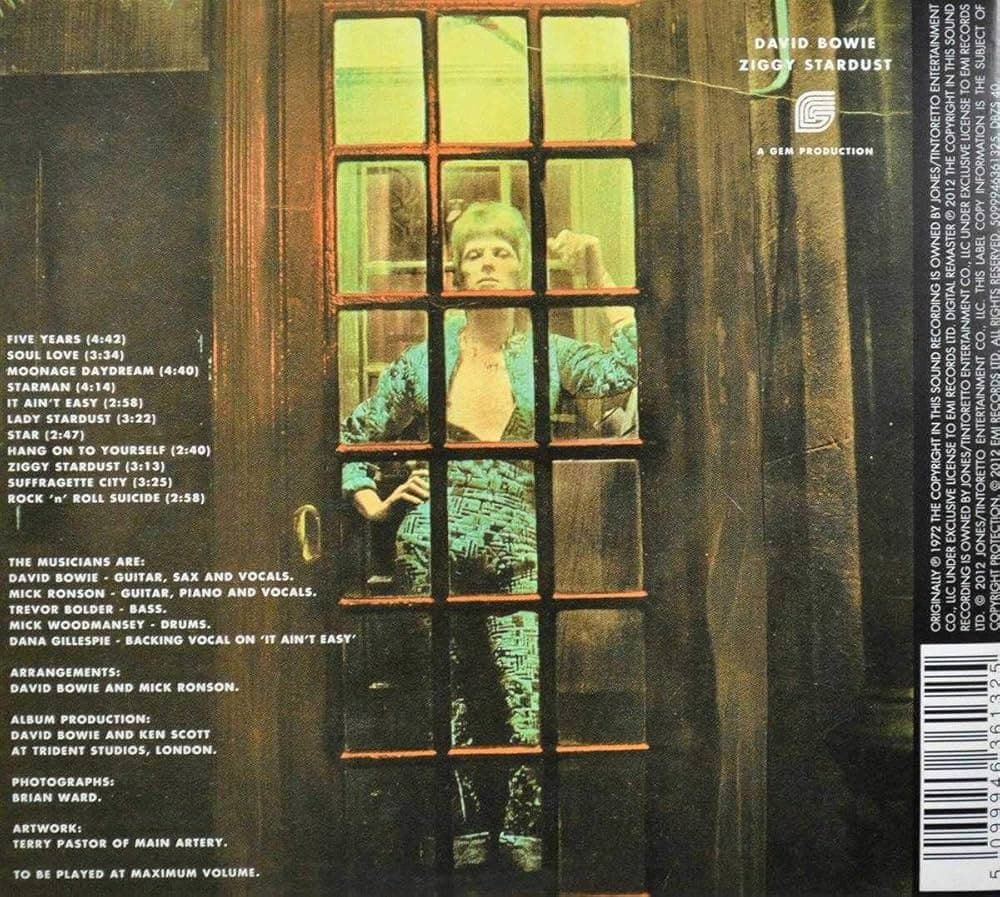
Flip the sleeve over and Bowie reappears, this time inside the Heddon Street phone box, beside a single firm instruction: 'To be played at maximum volume.' The album — a loose rock opera that became a defining glam statement — reached number five in the UK and seventy-five in the US, and has since been counted among Rolling Stone's 500 Greatest Albums.
The approach itself proved durable: a musician photographed in character, in a deliberately chosen location, presented as a single frame from an implied story. It fed straight into the visual language of glam rock. And the street kept the memory — in March 2012 the Crown Estate, which owns Regent Street, fixed a commemorative plaque to the wall of 23 Heddon Street, marking the exact damp corner where an alien once stood waiting under a furrier's light.