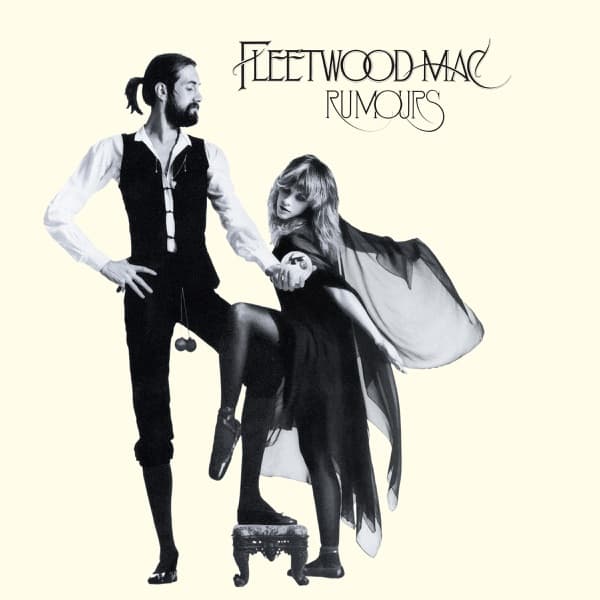
The cover of Rumours reduces a five-person band to two figures and a handful of strange props. Mick Fleetwood stands with one foot raised on a small stool, Stevie Nicks curls into a theatrical pose beside him, and a crystal ball catches the eye near the center. Then there are the two wooden balls hanging from Fleetwood's waist — a detail so odd that it has become almost as famous as the album itself.
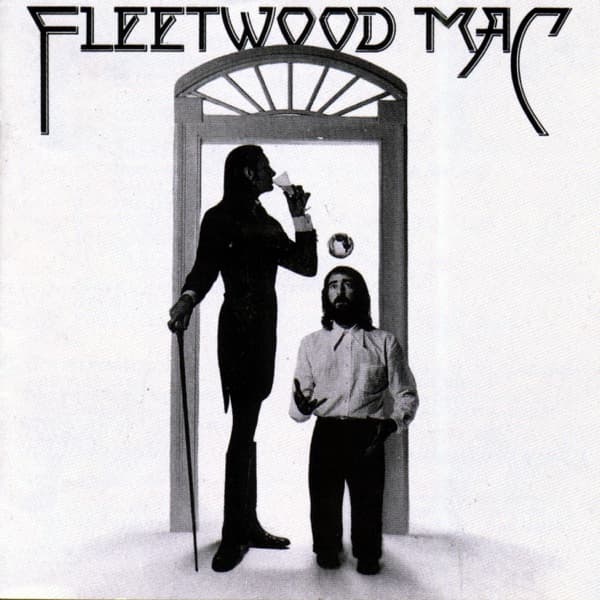
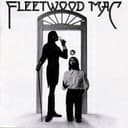
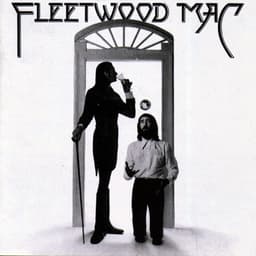
Photographer Herbert Worthington III already knew Fleetwood Mac's visual world. He had photographed the band's 1975 self-titled album, whose front cover also featured only two members: Fleetwood and John McVie. That earlier sleeve included a crystal ball, and the object returned for Rumours. Worthington again worked with a sparse setup rather than a full-band glamour portrait, this time pairing Fleetwood with Nicks.
Nicks's styling and pose are widely read as an extension of the theatrical persona surrounding 'Rhiannon,' which had become central to her stage presence by this period. That connection fits the image, but surviving accounts do not establish it as a formal brief for the shoot, so it is better treated as context than as a documented instruction. Fleetwood, meanwhile, brought his own history into the frame. In a 2009 interview he explained that the wooden balls originated with lavatory-chain pulls he took after drinking at an early British gig and then wore onstage; after the originals were lost, replacement sets continued the tradition.
Worthington also brought the small footstool under Fleetwood's raised leg. Contemporary cover-history reporting notes that its exact intended purpose is unclear. Visually, however, it became crucial to the finished composition: it lifts Fleetwood's stance, gives Nicks a shape to curl around, and helps turn a simple two-person portrait into something closer to a staged tableau. The crystal ball links the image back to Worthington's earlier Fleetwood Mac work, while Fleetwood's dangling wooden balls puncture the elegance with a piece of private band history.
The front image is only part of Worthington's contribution to the package. In the Classic Albums documentary, he singled out a sequence of photographs used on the reverse and inside as some of his favorite images from the project. During a rehearsal, John McVie unexpectedly crossed the room and hugged Lindsey Buckingham. Worthington kept shooting; Christine McVie and Nicks joined in while Fleetwood was left outside the group embrace. For a band whose relationships were fracturing, the spontaneous contact gave the package a second emotional register that the formal front cover does not reveal.
The album credits separate the creative roles clearly. Worthington is credited with photography and concept alongside Fleetwood Mac. Desmond Strobel handled the album design, and Larry Vigon supplied the hand lettering. The famous sleeve was therefore not simply a photographer's portrait dropped onto a jacket: the band and Worthington shaped the concept, Strobel designed the package, and Vigon gave the title its distinctive drawn lettering.
That combination is why the front cover survives as more than a publicity portrait. Nicks brings the theatrical language associated with her performances; Fleetwood brings an absurd object from the band's early stage history; Worthington brings props and a visual language he had already developed with the group. The result looks composed and mysterious, but almost every object in it carries a piece of Fleetwood Mac's own visual history.