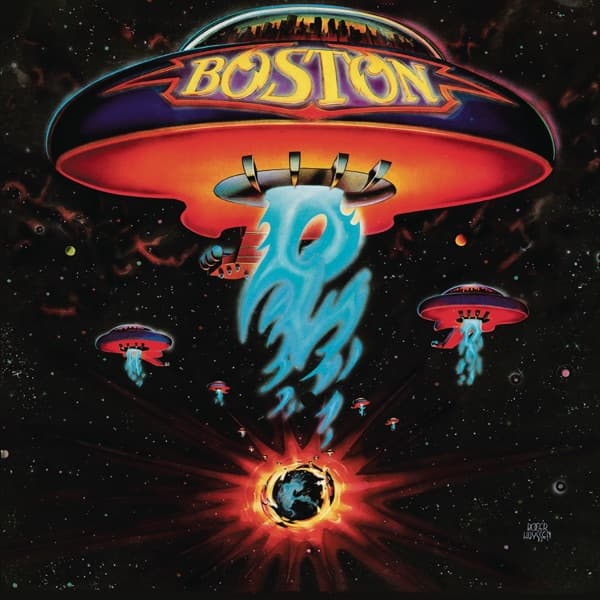
Look at the glowing wooden hull, the fiery blue jet shooting downward, the doomed planet cracking apart in a burst of orange below. Now flip the whole thing in your head. That sleek flying saucer is a guitar, turned upside down. The sound holes spew the flames, the neck becomes the tail. Most people stared at this for years and never noticed. When the trick finally surfaced and went viral on Reddit decades later, it played like a magic reveal a generation late.
The central craft dominates the frame, a burnished orange-and-red dome trimmed in chrome, with Boston spelled across its top in puffy gold script edged in blue, a custom logotype drawn by CBS Records typographer Gerard Huerta. A tiny skyline glints along the saucer's far rim. Around it, a whole fleet scatters into the black: smaller guitar-ships trailing the same icy blue fire, dim planets and stars dotting deep space, faint pinkish lightning streaking the void. The eye lands first on that vertical column of blue flame, then follows it straight down to the small blue-and-green Earth detonating in a halo of red light.
The concept came from Tom Scholz, the band's engine. "The idea was escape; I thought of a spaceship guitar," he said, and that single sentence is the whole image. Escape velocity, instruments fleeing a planet coming apart at the seams.
Getting there was not a straight line. The label's creative service department first chased Boston puns: Boston lettuce, Boston cream pie, an actual pot of Boston baked beans. All rejected, mercifully. An early take on the spaceship idea featured several guitar-city-ships labeled London, Paris, and Rome, with Boston biggest and front and center. The other city names got scrubbed to avoid confusion, leaving one hero ship and its silent armada.
The design was the work of Paula Scher, then art director at CBS Records, who turned the upside-down guitars into the spacecraft. The illustration that gave it dimension and that liquid, airbrushed glow came from Roger Huyssen, whose signature sits in the lower right corner. At CBS, Scher was turning out roughly 150 album covers a year, which makes this an early flash of the typographic, pop-culture instinct that defined her later career.
The craft stuck around. The guitar-shaped ship became a recurring trademark, reappearing on every Boston album that followed, a loose continuing storyline told in cover art. For a debut record, that is an unusual afterlife: the packaging outgrew the package.
Boston arrived on August 25, 1976, on Epic Records, a hard rock and arena rock debut whose sound was as polished and engineered as the chrome on that hull. The cover matched the music's ambition, all gleam and lift and escape. And yet Scher has said she is mystified by the lasting fascination with it. That may be the best part. The designer shrugs, the listeners flip the image over in their minds, and the guitars keep climbing out of the wreckage of a burning world.