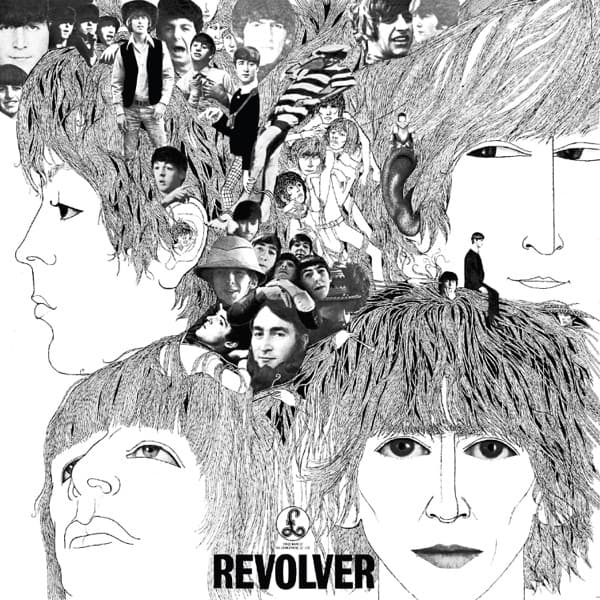
The cover works as a fusion of two techniques operating at two scales, and the tension between them is the whole point. Voormann drew four stylized portraits of the band in pen and ink, borrowing the sinuous line of the 19th-century illustrator Aubrey Beardsley, then set those large clean drawings against a dense black-and-white photo collage. Paul McCartney praised exactly this contrast, admiring how Voormann collaged tiny things on a small scale while the drawings loomed on a big scale, and felt the artist captured the band beautifully.
Compositionally, the four faces anchor the corners and center, their profiles and frontal views turned at different angles so the eye never settles into symmetry. The connective tissue is the hair. Voormann lets the manes swell far beyond any natural size, thickets of drawn strands that flow into one another. This does two things at once: it binds the four separate portraits into a single unified image, and it keeps each member's individual character intact within that unity. The hair is both fence and bridge.
Out of those tangles tumble the photographic faces, older images that appear to fall like memories being shaken loose. The reading offered is that each Beatle is caught "in another state of consciousness," their past selves and companions spilling from their heads. The collage of small human faces reads as interior life made visible, thought pouring out where hair should be.
The decision to work entirely in black and white is the most aggressive choice on the sleeve. Against the flower-power color of 1966 it reads as refusal, a graphic austerity that makes the image both shocking and, as Voormann intended, able to stand out in a muddle of color. Tonally the drawing is all high-contrast line, the collage all photographic grey, so the two registers of black and white sit distinctly even within a single palette.
Typography is almost withheld. The cover omits the band name entirely, trusting the title alone and the faces to identify the group. That confidence, refusing even to spell out who this is, treats the imagery as sufficient.
Secondary detail rewards the patient eye. Voormann tucked a hidden self-portrait into the work, his own face peering out from under George Harrison's hair on the center right, a signature buried in the crowd rather than announced. The whole image, a black-and-white bricolage of mini-Beatles, resolves into a portrait of a band turning inward, the exterior gloss of pop replaced by a swarm of interior faces, which is precisely why it suited music that had turned inward too.