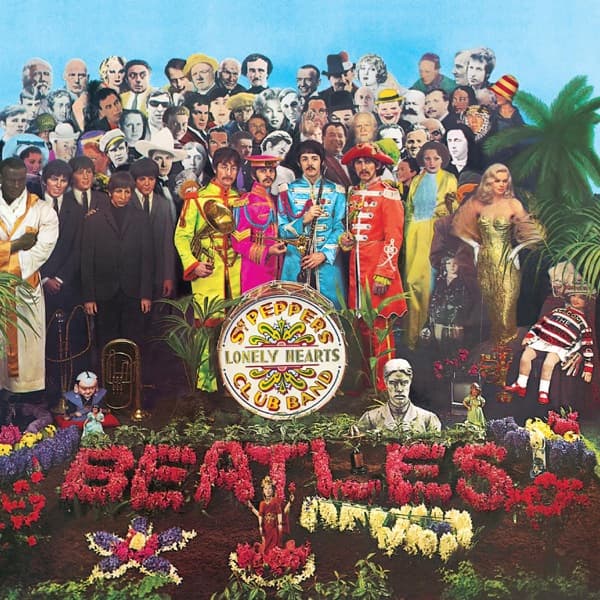
The cover is not a photograph of a painting or a montage but a record of a real, three-dimensional installation: a life-sized tableau built as a set and then shot straight, which is what gives the image its uncanny depth and physical presence. The Victoria and Albert Museum counts 88 figures in the finished collage, the four living Beatles included. They are arranged as a tiered group portrait, the crowd banked up behind the band the way a class or a football team lines up for a formal picture.
Michael Cooper's camera sits at eye level with the band, which quietly implicates the viewer: you are not looking at the crowd from outside so much as standing in it. The lighting reinforces that flatness. It is even and shadowless, deliberately anti-dramatic, closer to a Victorian group photograph or a fairground backdrop than to a rock portrait. With no atmospheric hierarchy to steer the eye, everything is equally visible and equally present, and the image becomes something to be read rather than glanced at, a visual text that rewards prolonged study.
Colour carries the argument. The band's uniforms blaze in saturated, full-spectrum psychedelia, and they clash joyfully against the muted sepia tones of the historical cutouts massed behind them. That chromatic collision between the monochrome dignity of dead heroes and the Technicolor exuberance of the living band is the cover's central claim: history is raw material to be remixed, not a museum to be preserved.
The assembly itself makes the same point through casting. Aleister Crowley, Mae West, Karl Marx, Marlene Dietrich, Bob Dylan, Aubrey Beardsley, Edgar Allan Poe and Stockhausen stand together with dozens more, an impossibly democratic gathering in which high culture and pop culture share a single row. Wax models of the earlier, suited Beatles stand among them, gazing downward. Every cutout was hand-coloured and mounted on hardboard, so the whole crowd has the slightly stiff, cut-and-pasted quality of a scrapbook brought to life.
The foreground is loaded with props chosen for maximum semiotic density: a portable television, a cloth doll wearing a Rolling Stones shirt, a garden gnome, a hookah. None of it is incidental. At the dead centre of the picture the bass drum carries the album's full title in a circus-poster typeface, integrating the text into the image instead of floating a caption above or below it, so that the words become part of the scene rather than a label on it.
That density is why the cover has sustained decades of analysis and conspiracy alike. Crowley's presence fed stories about the group's supposed occult affiliations. The waxwork Beatles staring mournfully at what looks like a grave suggested a ritual death and rebirth. A hand raised in apparent benediction above McCartney's head was read as an Eastern death sign. Whether any of these readings holds is almost beside the point. The picture is built to be over-read; its richness is the meaning. It is an image that keeps giving the eye more to find, and refuses to resolve into a single statement.