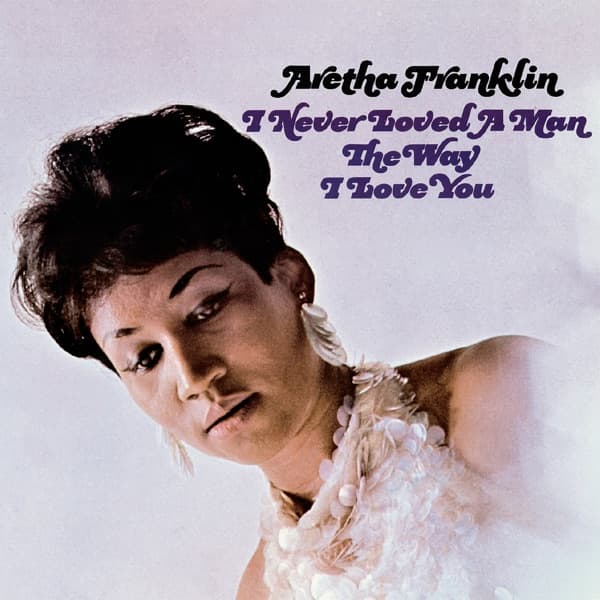
The composition is built on asymmetry and tilt. Franklin sits low and to the left, her head and shoulders anchoring the bottom corner while the upper right opens into empty, luminous space. That canted angle keeps the frame from settling; the eye enters at her face, slides down the line of her lowered gaze, then drifts up through the negative space to the title before returning to her. Nothing is centered, and the slight off-kilter framing gives the picture the feel of a caught moment rather than a formal portrait.
Her expression does the heaviest lifting. The eyes are cast down, the mouth relaxed and closed, the whole face turned inward. This is a quiet, un-posed expression, and its refusal to meet the viewer is what makes it magnetic: we are watching someone who is not watching us, which reads as private, contemplative, self-possessed. Rather than projecting star wattage, the portrait proposes interiority, and that emotional reserve becomes its own kind of authority.
The tonality is warm skin against a cool lavender-violet ground. Her face and shoulder catch a soft, natural-seeming light that models the cheekbone and the fall of her hair, while the paler wash behind her flattens into atmosphere. That contrast of warm figure and cool field pushes her forward and lends the image depth without any hard graphic device. Light is used to sculpt, not to dramatize; there are no harsh highlights competing for attention.
Texture is a quiet secondary player. The dark mass of her hair, the small pale ear ornament, and especially the fluffy pom-pom trim at her shoulder give the lower frame something tactile and delicate, a softness that answers the softness of her expression. The cropping is intimate, holding her close so that the shoulder and garment edge run out of frame, reinforcing the sense that we are near her rather than observing from a distance.
The typography is set to serve, not to shout. The title climbs the upper corner in a flowing italic swash, its curling strokes echoing the roundness of her hair and the informality of the pose. Because the lettering is confined to the open space above and beside her, it never overlaps her face or fights the image; it decorates the emptiness the composition leaves for it. The elegant script complements the portrait precisely by staying subordinate to it, an example of design that steps back so the subject can lead.
Read as a whole, the image works through restraint. Its meaning lives in what it declines to do: it does not glamorize, does not confront, does not fill every inch. A single figure, a soft field of color, a title tucked into a corner, and a downward gaze together propose that the woman pictured needs no ornament or spectacle to command the frame. The stripped-down presentation mirrors the stripped-down feeling of the music inside, and the quiet, inward pose transforms simplicity into strength. That is why so plain a picture holds: it treats stillness and self-possession as the whole event.