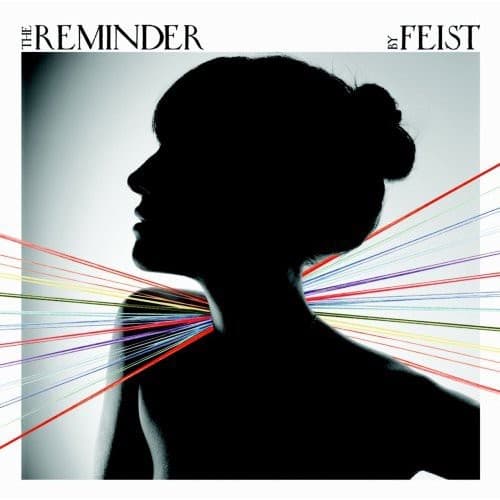

The cover of The Reminder did not begin as a paper collage, and it was not made by Kosta Karakashyan. Its real story is a collaboration among Feist, graphic designer Simone Rubi, photographer Mary Rozzi, and other visual contributors who were invited into the same creative world that surrounded the record. The finished sleeve reduces Feist to a dark profile silhouette while fine colored lines radiate outward from the image. The effect is restrained from a distance and increasingly intricate up close.
Feist already knew Rubi before the album campaign. Rubi had made merchandise while Feist was touring with Kings of Convenience, and the two found that they worked well together. When it came time to develop the visual identity for The Reminder, Feist asked Rubi to join her in Paris and work through the album's broader visual palette rather than simply deliver a finished cover from a distance. Rubi later described the process as an unusually open-ended collaboration: listening to the music, collecting materials, discussing light and color, and letting a vocabulary emerge around the record.
One of the important starting points was a mural Rubi had made with artist Nathaniel Russell. It showed two figures connected in many directions by colored thread. Rubi brought that idea into the Paris sessions as a springboard. Feist remembered the pair becoming fascinated by prisms, refraction and the way light could split into color. Those conversations helped establish the visual language that would eventually appear on the sleeve.
Photographer Mary Rozzi was part of that process as well. Feist said Rozzi began to understand the direction they were moving in and proposed the silhouette portrait. Rozzi made the photograph; Rubi then took that image and built the radiating-thread treatment around it. Feist characterized the result as genuinely collective raw material that Rubi ultimately shaped into the finished design. Release credits identify Rubi with graphic design, Rozzi with photography, and Tyler Clark Burke and Nathaniel Russell with additional design and illustration.
The silhouette also reflected Feist's preference for imagery that left something unresolved. Years later, when discussing the documentary Look at What the Light Did Now, she pushed back on the simple story that she merely refused to appear on the album cover. Her goal, she explained, was to find an image that was evocative rather than a conventional, plainly lit portrait. Rozzi's silhouette gave the photograph that ambiguity: Feist is present and recognizable, but the image does not behave like a standard celebrity headshot.
That distinction matters because the cover's power comes from the relationship between the photograph and the graphic system around it. The profile gives the composition a human center, while Rubi's colored lines turn that center into something closer to a diagram of connection, refraction or transmission. The artwork does not need a literal bird, flower or handmade-collage narrative to feel intimate. Its intimacy comes from the collaborative process itself and from the decision to show Feist indirectly.
The credits are unusually well documented. Contemporary release data names Simone Rubi for graphic design and Mary Rozzi for photography, while a later interview with both Rubi and Feist reconstructs how the cover was developed. Pitchfork's interview with Feist about the accompanying documentary also identifies Rozzi as the photographer who shot the album cover and records Feist's own explanation of why the portrait was made to feel less literal. Together, those sources give The Reminder a much stronger story than the invented collage account: it is a cover built through conversation among a musician, designer and photographer, with the final image preserving the mystery they were actively trying to create.