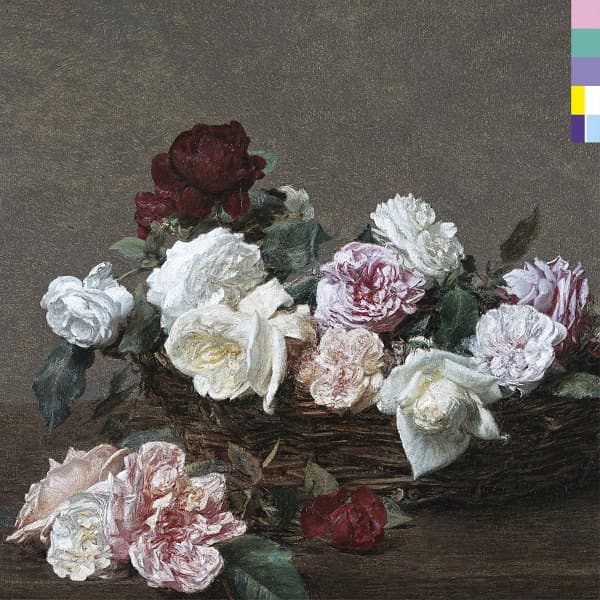
The painting is a study in controlled abundance. Fantin-Latour piles his roses into a low wicker basket on a plain table, and the flowers crowd toward the middle in a loose pyramid, their heavy heads tipping outward in every direction. The eye enters at the brightest spot, the cluster of cream and white blooms at the heart of the arrangement, drifts across the paler roses to either side, then catches on the single deep crimson rose near the top, the one saturated note in an otherwise soft field. That red is the anchor, and the composition keeps returning the gaze to it.
The palette is warm and restrained: peachy pinks, cream, ivory and blush, set against olive-brown leaves and a near-monochrome brown wall. Because the background is so dark and neutral, the flowers seem to hold their own light. The illumination is diffuse and soft, falling gently from the left with no hard shadows, which gives the whole image a romantic melancholy rather than drama. Nothing is sharp; everything is painterly, the petals built from feathered strokes rather than crisp edges.
Negative space does much of the emotional work. The upper left is almost entirely empty, a large expanse of shadowed wall that isolates the bouquet and surrounds it with hush. That emptiness lends the flowers a strange gravity, as if they were suspended in a still, quiet room. The painting fills the square sleeve to all four edges, with no frame and no lettering laid over the front, so the viewer meets the image the way one meets a canvas hung on a wall.
The most easily missed details sit at the bottom. At the lower left, several blooms have tumbled out of the basket and lie loose on the ledge, and a small red bud rests near the bottom center. These fallen flowers introduce transience into all the ripeness above: beauty already beginning to come apart, the quiet mortality that the still-life tradition has always carried. Roses at their fullest are roses about to drop.
Against this soft, organic world sits the one hard, modern intrusion: the block of coloured squares in the top right corner. Its edges are geometric and clean, its greens, lavenders, teal, yellow, blue and violet flat and un-painterly, a digital-looking grid pressed against the petals. It reads as a system laid over a surface, information concealed inside decoration. The squares are in fact a code, a colour alphabet that spells out the band's name and the album title without printing a single legible word.
That is where the image resolves into meaning. The sleeve offers seduction first, a bouquet so lovely it disarms, and only afterward reveals that something coded and deliberate is buried in the corner, waiting to be read. The tension between the tender roses and the cold cipher, between antique craft and encrypted message, is what makes the picture more than a pretty borrowing. Beauty is the way in, and beneath it lies a hidden order the eye cannot immediately decipher. Presenting unadorned beauty with neither irony nor aggression, and refusing even to name itself, the cover turns restraint into confidence.