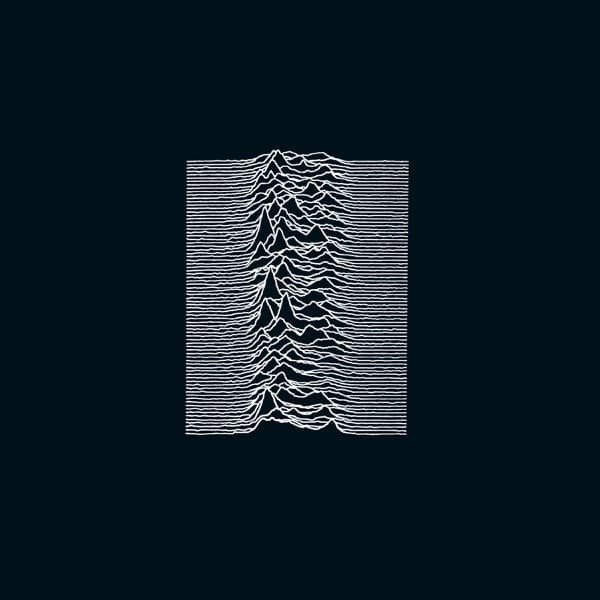
The image is built from a single dense block of white lines set precisely in the center of a black field, and the eye goes straight to it because there is nothing else to compete for attention. Each line runs nearly flat at its left and right extremes, then surges upward into a jagged peak toward the middle. Stacked one above another, roughly a hundred of them, the peaks pile into a form that reads at once as a mountain ridge seen in profile and as a heartbeat traced again and again. That double reading is the picture's engine: it hovers between landscape, biology and cosmos without settling on any one of them, so the mind keeps circling back to resolve what it is looking at.
Composition is almost aggressively simple. The block is centered and symmetrical enough to feel monumental, yet the individual traces wobble, fray and break, so the mass never hardens into a tidy logo. It floats as a small bright island in a large dark sea. The eye is pulled first to the tallest, most tangled peaks in the upper middle, then slides down the diminishing ridgeline as the pattern loosens and calms toward the base, giving the block a subtle sense of ascent, as if the viewer were looking up a slope.
Colour is reduced to two values, white and black, with no midtones to cushion the encounter. The high contrast makes the lines seem to push forward out of the surface. Printed on textured card, the white does not lie flat the way ink does; it takes on the quality of light, as though the shape were glowing from within the dark rather than being stamped onto it. That single reversal of tone is what gives the sleeve both its depth and its coldness, and it is the reason the marks feel less like a diagram and more like an emission.
Negative space does most of the emotional work. The black surround is vast relative to the marks it frames, and there is even a fainter black border holding a slightly deeper black rectangle, a quiet doubling that presses the cluster further into the void. The isolation lends the form the loneliness of a faint signal picked up across an enormous distance, small and precise inside an emptiness that dwarfs it.
Then there is the decision to hand the viewer no words at all. With nothing to read but the shape itself, the object stays mysterious; the design forces you to treat raw data as pure image, and it refuses to tell you whose it is or what it means. That withholding is exactly what makes the sleeve feel enigmatic rather than informational. It converts a scientific plot into an emotional field.
Put together, the choices resolve into a single haunting effect: an enigmatic imprint of an extinct star, glowing white and floating in black space, at once a physical measurement and an omen. The picture works because it is legible as a mountain, a pulse and a broadcast simultaneously, and because it delivers all of that without a caption, trusting the eye to feel the strangeness before the brain can name it.