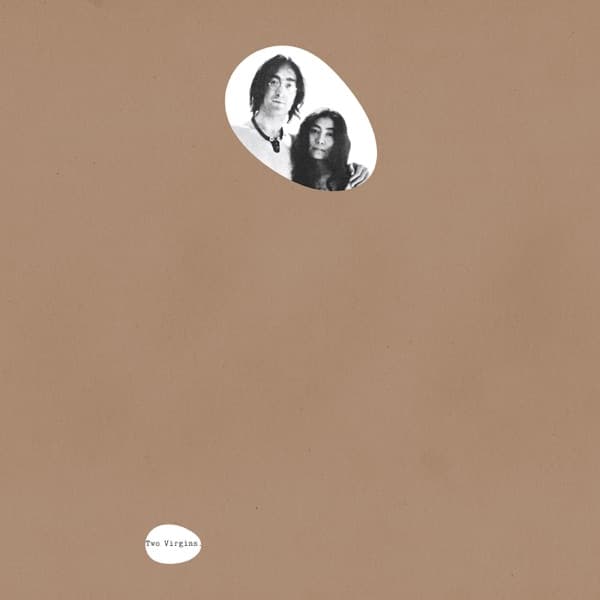
The most important thing to understand about Unfinished Music No. 1: Two Virgins is that the brown paper is not the album cover.
The original front sleeve is a full-length black-and-white photograph of John Lennon and Yoko Ono standing nude and facing the camera. The back reverses the pose: the couple is photographed from behind, turning their heads toward the lens. The plain brown paper package that became almost as famous as the photograph was added around the finished album so retailers and distributors could conceal most of the image.
That distinction matters because the censorship has gradually become tangled with the artwork itself. Surviving copies are often seen inside the wrapper, and photographs of the bag can look like an alternate minimalist sleeve. In reality, it was a cover-up in the literal sense: an outer layer placed over an image that had already been chosen as the album's visual statement.
Lennon took the photographs at 34 Montagu Square in Marylebone, the London flat owned by Ringo Starr where he and Ono were staying later in 1968. The National Portrait Gallery identifies the session as a time-delay self-portrait and notes that the full-length front and back poses were used for the record. Lennon later recalled that both of them felt embarrassed while undressing, which is why he used the delayed shutter rather than putting another photographer in the room.
The photographs were made after the music. In May 1968, Lennon and Ono had spent a night at Lennon's Kenwood home recording tape loops, voices, sound effects, piano fragments and other improvised noise. The record became their first collaborative experimental album. The title referred to the way they saw themselves at the beginning of their relationship: two innocents entering something new together.
Lennon also described the nude image as an extension of that idea rather than a publicity stunt. He wanted the photograph to look ordinary and human, not glamorous. In later recollections he emphasized that they deliberately avoided flattering lighting or a polished erotic pose. The bluntness is the point. They stand upright, close together, against a nearly empty background, presenting their bodies with the same lack of decoration that the record applies to sound.
The official John Lennon archive credits the cover design to John Lennon and Yoko Ono. That role is easy to miss because there is so little conventional graphic design on the front: no large illustration, no elaborate logo, no staged environment. But choosing the self-portrait, pairing the frontal and rear views, and making that directness the package's identity were design decisions in themselves.
The trouble began before many buyers had a chance to see the record. EMI would not distribute it with the nude sleeve, so other distributors handled the release. Apple staff were put to work placing copies inside brown paper wrappers for sale. Depending on the pressing and wrapper, the outer package exposed only limited identifying information while obscuring the bodies underneath.
The wrapper solved only part of the problem. Some shops still refused the album, and authorities treated the sleeve as obscene in several places. In January 1969, roughly 30,000 copies were seized in New Jersey. The incident helped turn a small experimental record into one of the defining censorship stories in album-cover history.
That controversy can make the photograph seem more sensational than it actually looks. The front sleeve is stark rather than theatrical. There is no seductive staging and almost no visual distraction. Lennon and Ono simply occupy the center of the frame as themselves. The gap between that plainness and the enormous reaction around it is what gives the image its lasting force.
Today the two parts of the package tell different stories. The nude photograph is the artwork Lennon and Ono chose. The brown paper is evidence of what happened when that artwork entered the marketplace. Keeping those two objects separate makes the history more interesting, not less: one is a private self-portrait made public, and the other is the physical record of an industry trying to hide it.