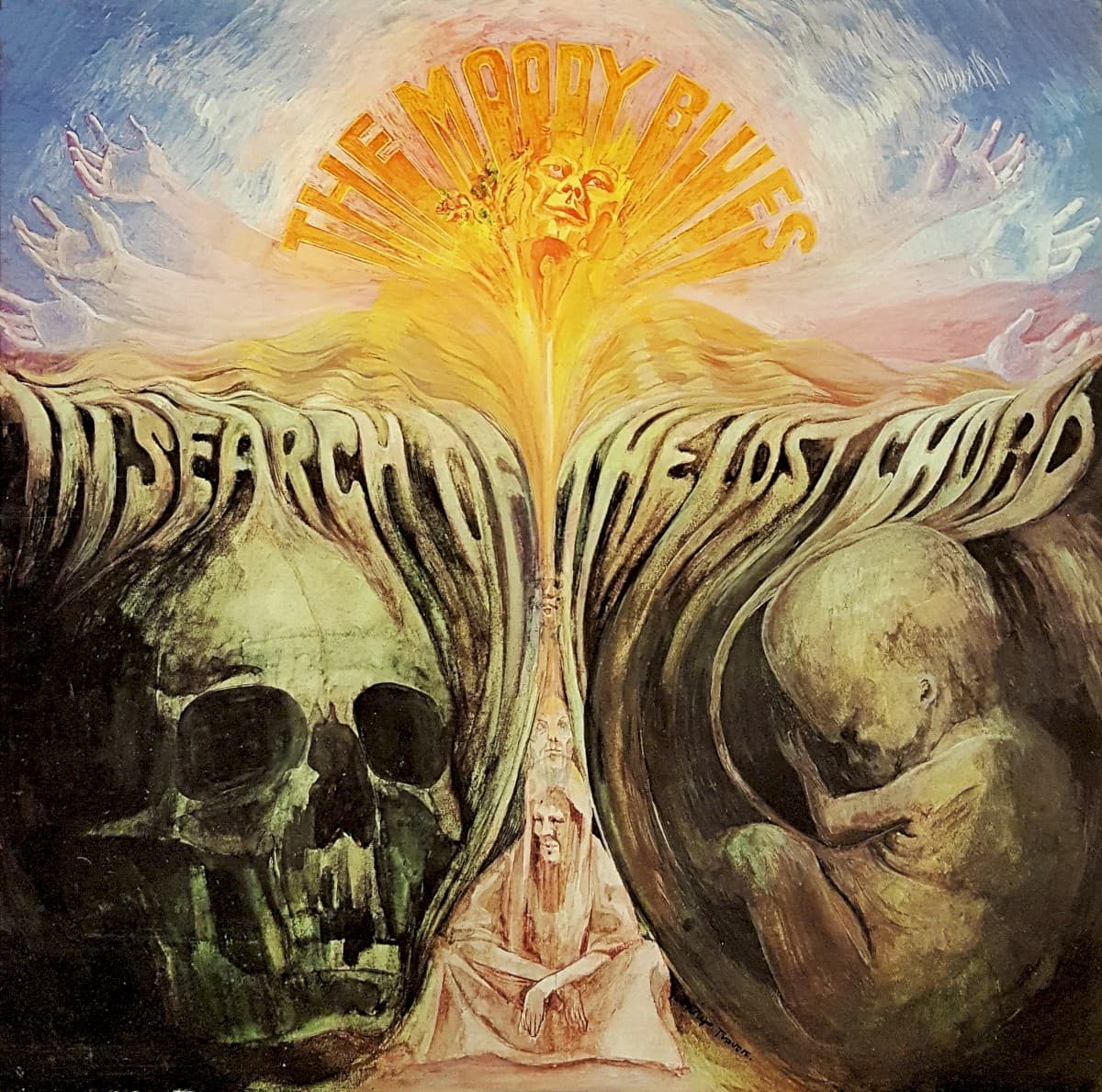

Philip Travers did not arrive at the cover of In Search of the Lost Chord with an easy answer. The Moody Blues wanted an image about meditation—an abstract brief for an artist who later admitted that meditation was not something he knew much about personally. His first ideas were not working, the deadline was getting closer, and the commission began to feel dangerously unresolved.
Travers had come through Decca's art department before moving to a design office in Wimbledon. A former Decca colleague told him that the Moody Blues' manager had noticed one of his illustrations, which led to a meeting with the band in a London pub. From there, Travers was invited into the group's creative process rather than handed a finished marketing instruction. He listened to the music, discussed its themes with the musicians and tried to find a visual equivalent.
The breakthrough happened in the recording studio. Travers was sitting on one side of the large glass window separating the control and performance areas when he noticed multiple reflections of himself stacked in the glass. The repeated figures seemed to rise upward, almost as though one body were ascending into space. The image stayed with him. When he returned to the problem of illustrating meditation, that accidental reflection supplied the structure he had been missing.
Travers later described the band's central request very clearly: they wanted him to illustrate meditation. The ascending figure allowed him to turn an invisible mental process into a physical journey. Rather than paint somebody simply sitting with closed eyes, he could suggest consciousness leaving ordinary space and moving through successive states.
The finished artwork was made with gouache and watercolor, with Travers frequently using an airbrush. Those techniques help explain the cover's peculiar combination of solid figurative detail and hazy, otherworldly atmosphere. The image does not present one clean symbol that can be translated into a sentence. It behaves more like a dream assembled from recognizable fragments.
That ambiguity is appropriate to the record. In Search of the Lost Chord explores travel, altered perception, philosophy, mysticism and the idea that the missing “chord” might be less a musical object than a form of understanding. Travers did not attempt to diagram every song. Instead he built a visual environment capable of holding those ideas together.
The collaboration also proved important beyond this single album. Travers went on to work on a run of Moody Blues sleeves, and he remembered the band as actively involved throughout the process. Typically they would listen to the music together and discuss themes; he would produce a pencil rough; the group would respond; and only after a consensus would the finished painting begin. The deadlines were often punishing, sometimes requiring him to work through day and night.
That working method makes In Search of the Lost Chord more than generic psychedelic decoration. The sleeve emerged from direct contact with the album while it was being made. Its central image was literally discovered while Travers sat inside the recording environment, watching his own reflection transform in the glass.