




The Surfer Rosa cover looks like a scene found in a half-abandoned Spanish bar: a topless flamenco dancer twists across the frame, a crucifix hangs behind her, a torn poster and broken guitar neck crowd the wall, and the whole room feels hot, improvised and slightly unreal. The setting was not Spain. Vaughan Oliver and photographer Simon Larbalestier built the image in a pub opposite 4AD's London office because, as Oliver later put it, they could not afford a studio.
The Spanish atmosphere did not come from nowhere. Oliver said he developed each sleeve by listening to the music, reading the lyrics and talking with the artist. With Pixies, Charles Thompson — Black Francis — was interested in nudity, while the two men also shared an interest in film and David Lynch. Oliver connected the Surfer Rosa idea to Thompson singing 'Vamos' in Spanish and to the singer's time in Puerto Rico as an exchange student. Flamenco gave them a traditional visual language they could deliberately disturb.
That disturbance is the key to the image. Oliver described flamenco as proud and traditional, then said that subverting it gave the scene a decadent perspective. The dancer's toplessness works against the formality of the pose rather than simply functioning as provocation. The crucifix adds another established symbol to the room, while the damaged surfaces and dislocated objects make the scene feel less like a performance photograph than a fragment from a story whose beginning and ending are missing.
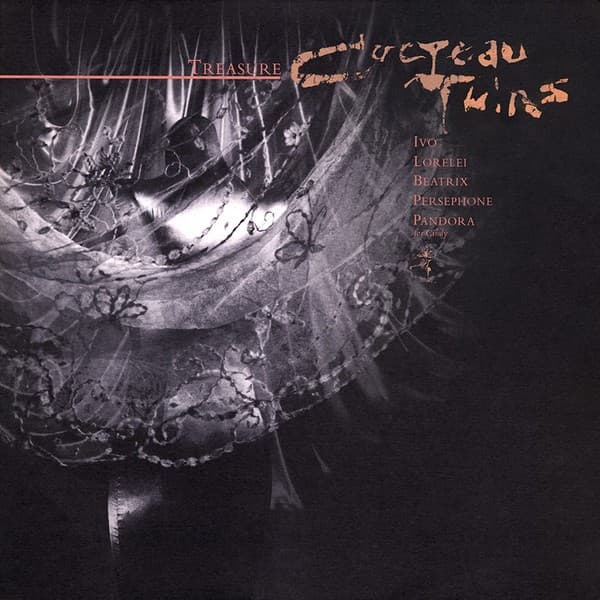
One of those objects came directly from 4AD's orbit. Oliver identified the broken guitar neck in the photograph as belonging to Cocteau Twins guitarist Robin Guthrie. That detail turns what appears to be anonymous set dressing into a small piece of label history: Pixies' emerging visual identity was being assembled with material from the same creative world that had already shaped 4AD's reputation.
The photograph was made by Simon Larbalestier, with Oliver and 23 Envelope credited for the sleeve's art direction and design. Their collaboration became central to the visual language of Pixies' early records. Rather than photograph the band conventionally, they built images around fragments of lyrics, cultural references and objects that could carry mood without explaining the songs. Surfer Rosa established that approach before Doolittle pushed it further into symbols, specimens, numbers and grids.
The woman on the front is widely identified in later secondary sources as Portuguese dancer Isabel Tamen, but the strongest primary and archival sources available for the shoot do not independently establish her name as an original sleeve credit. That distinction matters on a page built around a frequently searched question about the model: the identification can be reported, but it should not be presented with more certainty than the surviving evidence supports.
4AD lists Surfer Rosa as released on March 21, 1988. More than the date, though, the sleeve marks the point at which Pixies acquired a visual world as distinctive as their sound. A low-budget pub set, a dancer, a crucifix and a borrowed guitar fragment were enough. Oliver and Larbalestier made the limitations part of the atmosphere, producing an image that feels simultaneously staged and discovered — exactly the tension that keeps the cover difficult to place even after its real location is known.