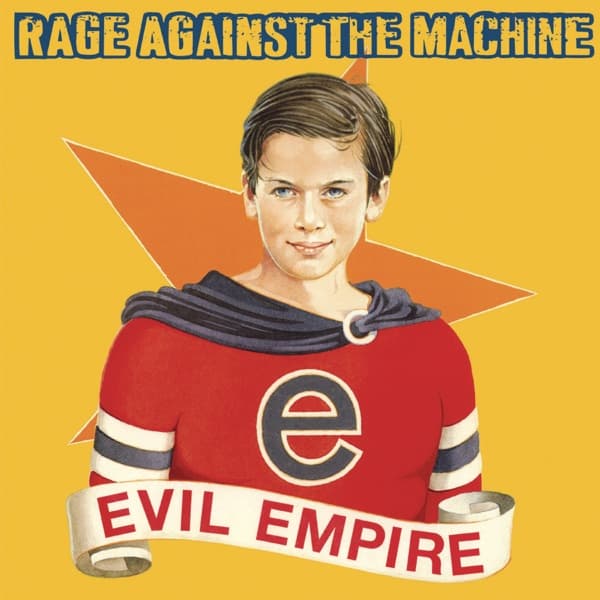
This is not a photograph and not a band portrait. It is a painting, rendered in a clean, flat, affectionate style that reads like a mid-century comic panel rather than any real child. The technique matters: the smooth illustrated finish presents the boy as an ideal, a type, an American superboy rather than an individual, and that idealization is exactly what the cover later weaponizes.
The composition is frontal and symmetrical, built to hold you. The boy is centered and cropped at the chest, filling the frame, while the orange star radiates outward behind him like a halo or an insignia backing. The mustard-yellow field is loud and warm, pushing the scarlet jersey forward; the palette is agitprop dressed as consumer packaging, sweet and saturated and hard to ignore. The eye enters at the face, drawn by the flushed cheeks and the small smile, then is pulled down the vertical axis to the chest emblem and finally to the banner, so the reading happens in sequence: innocence first, label second.
The comic-book DNA is everywhere once you look. The cape, the athletic jersey, the emblem centered on the chest like a team insignia, the striped cuffs: all the visual grammar of a costumed hero. The lettering does its own work. The spiky serif band name at the top and the blocky red capitals of the title in the scrolling ribbon frame the figure top and bottom, boxing the boy inside the words.
What you are actually looking at, though, is a doctored image, and the alterations carry the argument. The emblem on the boy's chest was changed from a 'c' to a lowercase 'e'. The caption that once ran along the bottom was swapped out for the album title. And the color of the background star was changed. Three surgical edits turned a wholesome poster child into a piece of political art: the innocent boy now branded with the letter of an 'empire', playing at being a superhero while the mark on his chest suggests darker intentions.
The phrase itself is Cold War language turned back on its source. 'Evil empire' was Ronald Reagan's early-1980s label for the Soviet Union, and the band pointed it at the United States, feeling the term applied just as well at home. That inversion is the joke and the thesis of the image: the all-American superboy, wholesome and star-backed, wearing the mark of the very empire he might once have been drawn to defend. The gap between the picture's innocence and the words beneath it does the arguing.
The power comes from restraint and from a single letter. Nothing here signals aggression on its own. The star, the ribbon, the beaming face all belong to a birthday-card visual world. It is only the swapped emblem and the title that reframe the whole thing, so that the trusting smile curdles on a second look into something smug, a face that reads as innocence and menace at once depending on which word you have read.