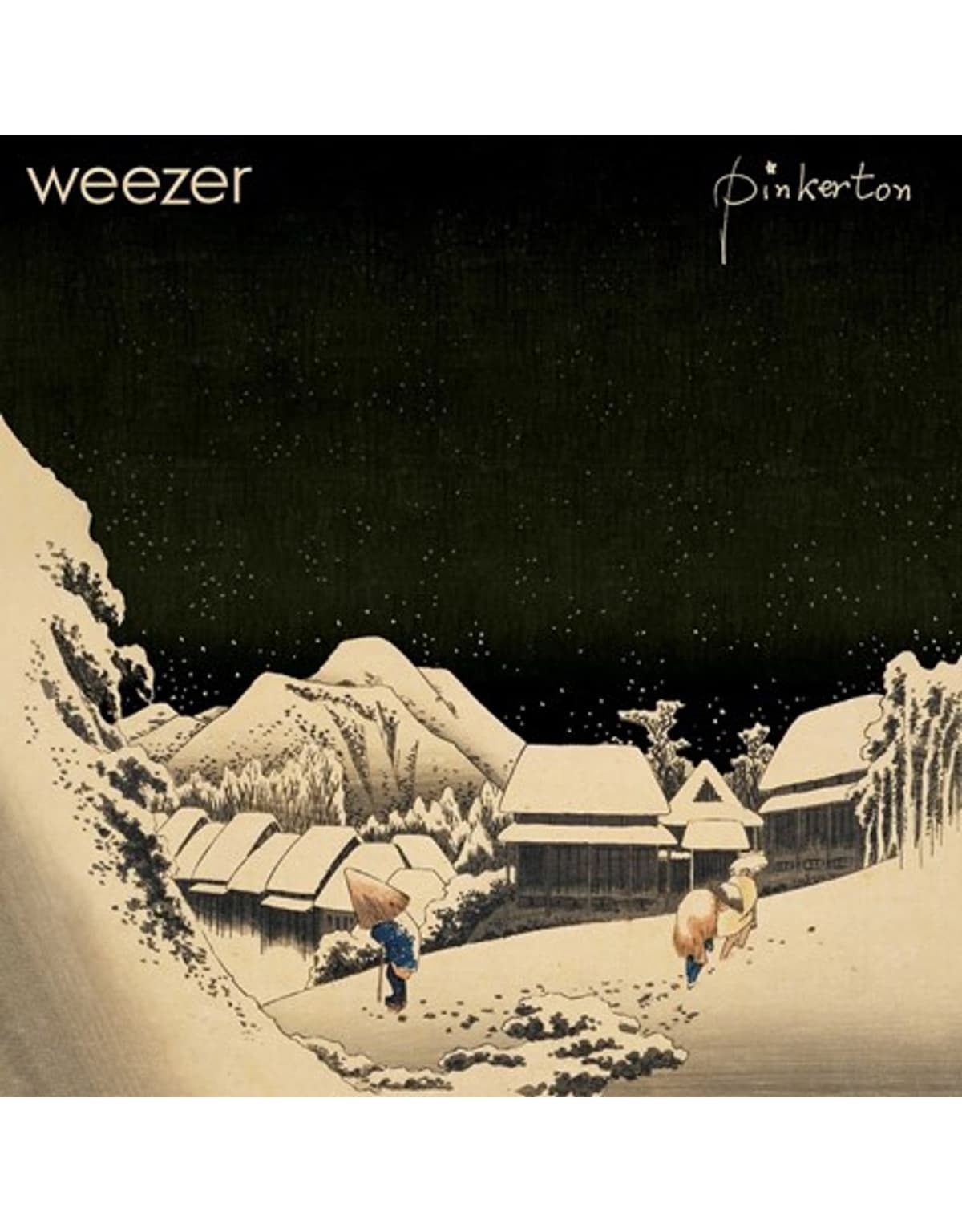


Pinkerton does not open with a photograph of Weezer, a posed band portrait, or a piece of new commercial illustration. Instead, it borrows a landscape that was already more than 160 years old when the album arrived in 1996: Utagawa Hiroshige's Evening Snow at Kanbara, from the celebrated Fifty-three Stations of the Tōkaidō series. The original woodblock print dates to about 1833–34 and shows travelers picking their way through a village almost swallowed by snow. On the album cover, the image is framed by a deep dark sky, with the band's lowercase name at upper left and the handwritten Pinkerton title at upper right.
The choice is more tightly connected to the record than it may first appear. Pinkerton takes its name from B. F. Pinkerton, the American naval officer in Giacomo Puccini's Madama Butterfly. Weezer's own label description of the album explicitly connects the title and the record's Japanese references to that opera. The packaging continues the connection: lyrics from Madama Butterfly appear on the CD, while a map behind the tray carries an Italian title and includes the U.S.S. Pinkerton. The Japanese landscape on the front therefore is not decorative atmosphere pasted onto an unrelated record. It sits inside a larger visual and literary frame built around Pinkerton, Butterfly, travel, distance, and an American gaze toward Japan.
The album's original credits are unusually useful because they separate the different visual roles. Hiroshige is credited for the cover art, specifically Kambara: Night Snow. Kyung Hee Kim is credited for lettering, Janet Wolsborn for art assistance, and Spike Jonze for photography. That distinction matters: Jonze is the package photographer, but the front cover itself is not one of his photographs. The image comes from Hiroshige's woodblock print. Treating all of those roles as one generic 'designer' credit would flatten what the sleeve actually is: a nineteenth-century artwork adapted into a 1990s record package by a separate production team.
The landscape itself carries a small surprise. The Metropolitan Museum of Art notes that Hiroshige's snowbound Kanbara is essentially imagined. Records indicate that he passed through the area in summer, and the kind of heavy snowfall pictured would have been unusual there. That makes one of Pinkerton's most recognizable visual cues — the almost total burial of the village in white — less documentary than poetic. Hiroshige was not simply recording a winter stop on the road. He was constructing an idealized, silent snow scene.
That quiet is one reason the image works so well against the music. Pinkerton is famously abrasive, confessional, and emotionally exposed, but the cover does not try to illustrate any of that directly. No anguished face appears. No band member is visible. Instead, the eye enters a landscape of distance and isolation: tiny travelers against large dark forms, houses partly erased by snow, a road that seems to disappear into the scene. The cover gives the album emotional space rather than a literal synopsis.
The result is one of Weezer's least self-promotional sleeves. Compared with the instantly recognizable band portrait of the Blue Album, Pinkerton turns away from the group entirely. Its front cover asks the viewer to look outward, into an older image and another cultural tradition, even while the songs move inward toward some of Rivers Cuomo's most personal writing. That tension is central to the cover's staying power: an intimate, difficult record wrapped in an image of cold distance and near-silence.