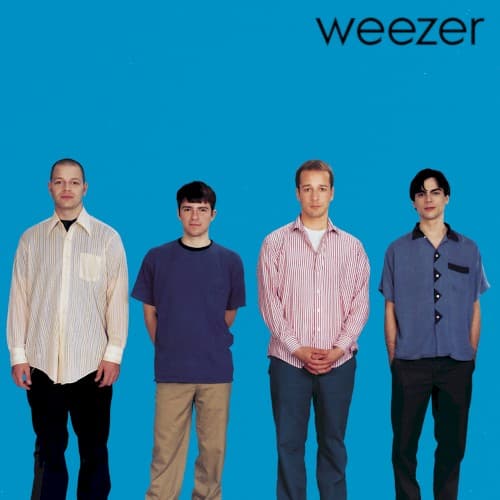

The cover of Weezer looks almost too simple to have required much planning: four band members standing in a row, a flat blue background and a small wordmark in the corner. The story behind it is more considered than the image first suggests.
Geffen hired veteran photographer Peter Gowland to shoot the cover. Gowland was best known for glamour and pin-up photography, an unexpectedly polished choice for a band whose final portrait would look so plain. The session took place at his home in Pacific Palisades.
The band did not begin with the clothes seen on the finished sleeve. Rivers Cuomo had imagined matching striped shirts in the spirit of the Beach Boys. Photographs were also taken with the members in their regular clothes, and those were the images they preferred. Brian Bell wore a favorite vintage bowling shirt; Patrick Wilson arrived with his head shaved. Instead of a coordinated costume, the final cover captured four people who looked like themselves.
Then there was the blue. Bell later remembered that the band spent about two days looking for the right shade. That choice turned out to be as important as the portrait. The color is so dominant — filling nearly every inch not occupied by the band — that it eventually supplied the album with the name fans use to distinguish it from Weezer's many other self-titled records.
The final sleeve credits separate the work clearly: Gowland made the cover photograph, Karl Koch handled the design, and Michael Golob is credited with art direction. Their roles disappear easily into the image because the finished cover feels so effortless.
The typography follows the same instinct. The lowercase Weezer wordmark sits quietly in the upper-right corner, small enough that the blue field and the four figures remain the first things you see. Nothing competes for attention. The band stands there, the color surrounds them, and the logo simply tells you who they are.
That restraint became the cover's strength. It does not need a dramatic pose, location or visual effect to announce itself. A group portrait, a precisely chosen color and a tiny wordmark were enough to create an image Weezer would spend decades returning to.