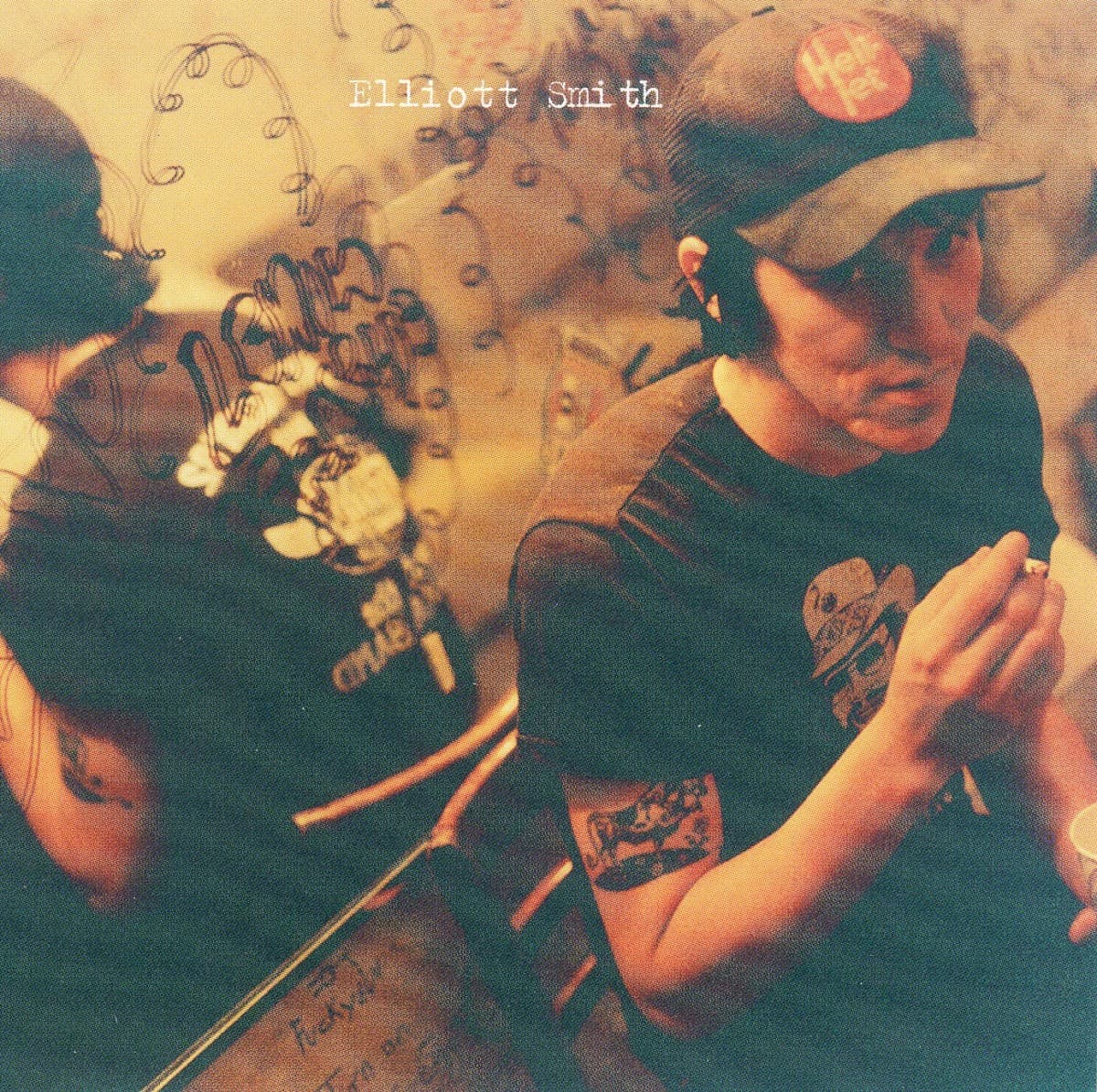

The cover of Either/Or feels private because it began as an ordinary backstage moment rather than an elaborate album-cover shoot. Apple Music identifies the scene as a now-defunct club in Arizona in 1996, where Elliott Smith was opening for Sebadoh. Smith sits in front of a graffiti-covered mirror, cigarette in hand, looking upward rather than directly performing for the camera.
The original Kill Rock Stars LP credits Debbie Pastor with the front-cover photograph, Joanna Bolme with the back photograph and Neil Gust with the layout. Those credits are corroborated by discographical documentation and later credit databases. Gust was not an anonymous art director: he and Smith had known each other since college and co-founded Heatmiser, making the sleeve another product of the close creative circle around Smith's Portland years.
A recollection published by Phoenix New Times adds useful context to the photograph. Writer and former local DJ Shane Kennedy remembered being backstage with Smith and Sebadoh's tour manager while 'Debbie' took pictures; one of those photographs, he wrote, became the cover of Smith's next record. That memory fits the credited photographer and the Arizona/Sebadoh setting documented elsewhere.
Nothing about the finished image tries to manufacture grandeur. The mirror is marked with graffiti, the room feels cramped and temporary, and Smith appears caught between moments rather than posed as a star. Neil Gust's restrained layout preserves that quality instead of burying it under a larger graphic concept.
That casualness became unusually appropriate for Either/Or. Much of the record was made in houses and modest recording spaces, and Smith's performances often create the sensation that the listener is physically close to him. The cover gives the album a visual equivalent: not a celebrity portrait, but a glimpse of a musician backstage on tour, surrounded by the residue of a small club.
The title adds another layer. Either/Or takes its name from Søren Kierkegaard's 1843 philosophical work. Smith studied philosophy at Hampshire College, and the title's tension between alternatives suits a record made at a transitional point: between Portland and wider recognition, between home recording and more expansive production, and shortly before his music reached a much larger audience through Good Will Hunting.