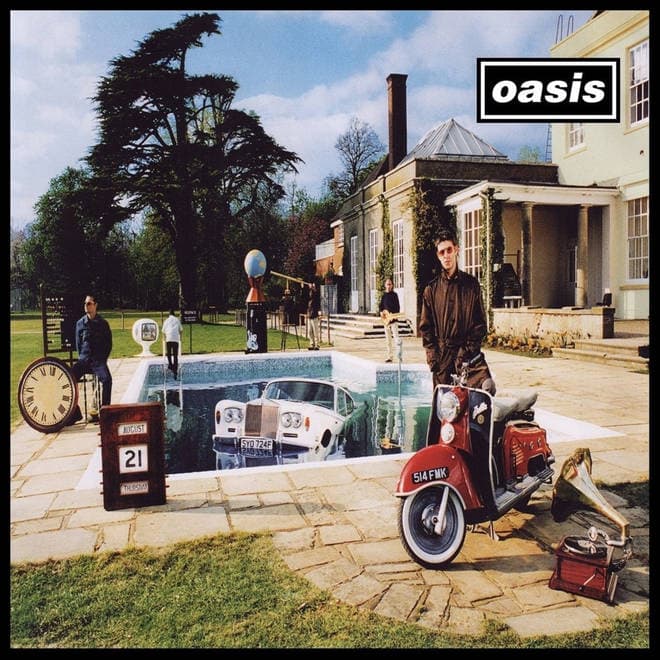
By the time Oasis made Be Here Now, understatement was no longer part of the brief. The band's third album arrived after the enormous success of Definitely Maybe and (What's the Story) Morning Glory?, and its cover scales up the same mythology: five band members, a country house, a swimming pool, a wrecked luxury car, and enough strange objects to make the whole scene look less like a photograph than a dream somebody had about rock stardom.
Designer Brian Cannon and photographer Michael Spencer Jones built the image at Stocks House in Hertfordshire. The location gave them the grand exterior and pool they needed, while the centerpiece came from a story Paul 'Bonehead' Arthurs had mentioned about Keith Moon putting a car into a swimming pool. Cannon later recalled that the Rolls-Royce used for the shoot was a damaged scrapyard car. Rather than fake the effect, the production team physically lowered it into the pool, a process Cannon said took two days.
That detail is important because the sleeve can look almost suspiciously artificial now. The white Rolls-Royce seems too neat and too small in the blue water, as if it had been pasted into place. It was not. The car really was sitting in the pool. Around it, the cover piles on more visual interruptions: a red scooter in the foreground, a gramophone on the paving, an oversized clock, a globe, a television, and a calendar block showing the album's British release date, August 21. The official Oasis archive itself describes the cover as the band outside a grand country house with a Rolls-Royce in the swimming pool, a red scooter and gramophone in the foreground.
It is tempting to treat every one of those props as a clue. Contemporary and later accounts do not support that reading. NME reported that the objects came from the BBC prop store and that, according to the band, they were not assigned a precise symbolic meaning beyond looking right in the picture. Cannon has been more specific about the car: the starting point was Bonehead's Keith Moon story, and the submerged Rolls-Royce became the cover's great act of rock-and-roll excess. The safest way to read the sleeve is therefore as a mixture of one clear rock-myth reference and a larger collection of objects chosen to make the scene stranger, richer and more memorable.
The photograph people know was not exactly the image Spencer Jones first expected to make. He has said the session was originally conceived as a night shoot. During the day, drinks circulated among the band and crew; later, one of the generators failed just as he was preparing to shoot after dark. Working with slow film and insufficient light, he ended up with badly underexposed night frames that could not be used for the album. Years later, digital recovery made one of those near-lost images visible again. Spencer Jones has said that recovered night photograph is probably closer to how the cover should have looked.
Instead, the daylight image became definitive. Liam Gallagher stands nearest the camera beside the scooter, with the other members distributed across the pool and lawn. The arrangement is open enough to let the eye wander rather than locking onto a single focal point. The band are present, but the props compete with them for attention. It turns Oasis into one element inside their own spectacle.
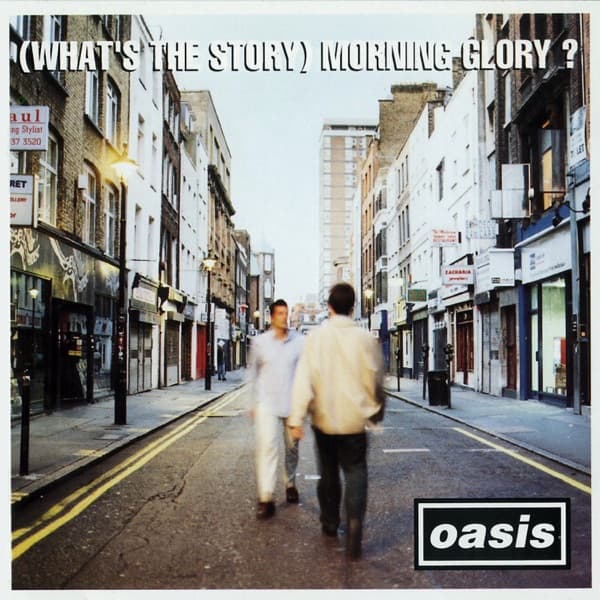
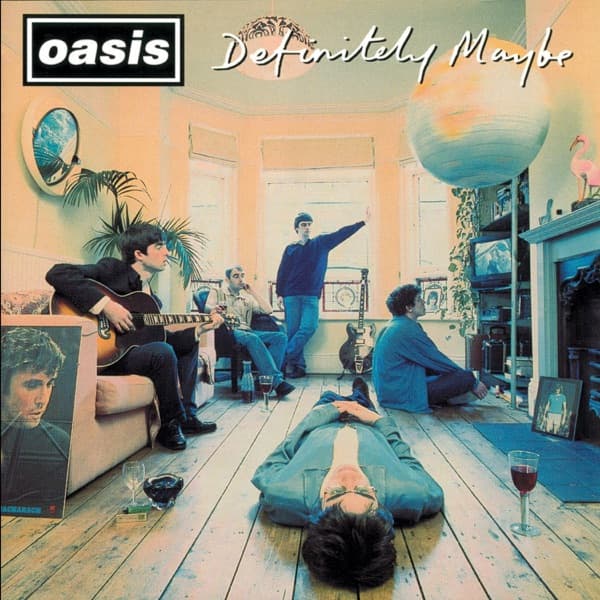
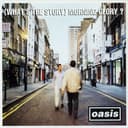
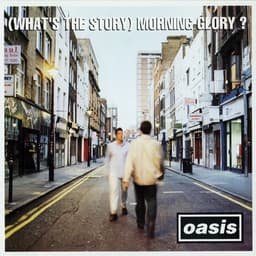
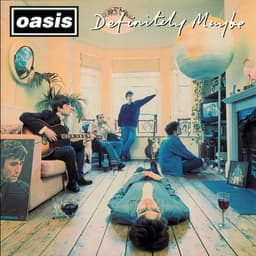
That makes Be Here Now a useful endpoint to the visual run Cannon and Spencer Jones created for the band's first three studio albums. Definitely Maybe made mythology out of a cramped domestic room. Morning Glory turned an ordinary Soho street into something cryptic and cinematic. Be Here Now takes the next step and makes the mythology physically expensive: a stately setting, a car in a pool, oversized props, and a production elaborate enough that even the failed version of the photograph has its own afterlife. The cover does not simply document Oasis at their commercial peak. It performs the scale of that moment.