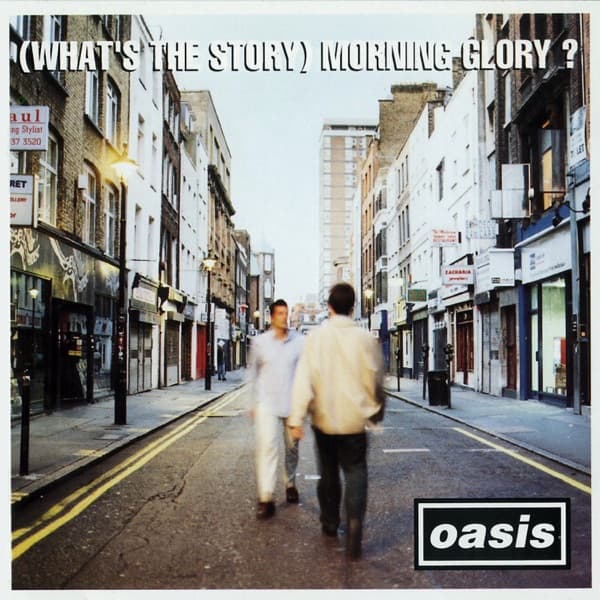
Look closely at the two men walking away from you and you notice something odd: their bodies are sharp but their edges dissolve, as if the pavement is remembering them rather than showing them. One wears pale grey, one wears cream, and they pass on a wet-looking Soho street at an hour when London has forgotten to wake up. For thirty years people have sworn those blurred figures are Liam and Noel Gallagher. They are not.
The two men are DJ Sean Rowley and Brian Cannon, the sleeve designer himself, who ended up in his own artwork. The brothers were meant to be there. They didn't turn up. The reasons shift depending on who tells it, too much drink after staying up all night, a stomach upset, being away on tour, but every version ends the same way: no Gallaghers on the Gallaghers' record. So Cannon put himself and Rowley into the frame and let strangers become the faces of one of the biggest-selling albums Britain ever made.
The location is Berwick Street in Soho, ordinarily one of the busiest streets in London. Here it is scrubbed clean of traffic, not a single car, only the double yellow lines curving down the centre of the road like a road-marking arrow pointing the eye toward the tower block rising in the pale distance. Shop shutters and signs line both sides, a hairdresser's board on the left, jewellers and a restaurant sign on the right, awnings and graffiti and the ordinary clutter of a working street. It took an early-morning shoot to catch it this empty, and that emptiness is the whole atmosphere: a real place made to feel like a held breath.
The title runs across the top in plain white letters, wrapped in brackets and ending in a question mark: (What's the Story) Morning Glory? That punctuation is not decoration. The concept grew from a Noel Gallagher saying, that there aren't ever answers, only ever more questions, and the picture makes the idea physical: two strangers passing in the street with no clue who they are or where they're going. The question mark on the sleeve is the thesis of the image. You are not supposed to know these men. That is the point.
There is a third figure most people miss. Back on the left, half-swallowed by the shadow of the buildings, stands the album's producer Owen Morris, holding the master tape of the record up in front of his own face. He literally hides behind the music he made. Once you spot him, the composition tilts from a simple street scene into something sly and self-referential, the sound of the album smuggled into the picture of it.
Brian Cannon designed the sleeve through his company Microdot, the outfit behind so many Oasis covers, and the photograph was taken by Michael Spencer Jones. Their reference points were deliberate. There is the ghost of The Freewheelin' Bob Dylan, released thirty years earlier, and there is Pink Floyd's Wish You Were Here, which also hinges on two mysterious men. Both feed the same instinct: put human figures in a real place and let the mystery do the work.
The most quietly astonishing fact about the image is that it was the very first shot taken that morning. Cannon was still working with an analogue camera, so there was no screen to check, no instant confirmation. He shot the frame, kept shooting, packed up, and only discovered the next day, after the film was developed, that the opening exposure was the one. Everything that followed on the roll was chasing a picture he had already captured without knowing it.
The album arrived on 2 October 1995 through Creation Records, the indie label that suddenly found itself carrying a phenomenon. Roughly 22 million copies went out into the world, making it the biggest seller for both Oasis and Britpop itself, and the picture rode along with the songs until it became one of the most instantly recognisable and most-copied sleeves in music. Part of that reach comes from how little the image insists on. No band photo, no faces, no swagger, just a street and two backs walking away.
The only assertive graphic element sits in the bottom right corner: the word oasis in lower-case white letters inside a black rectangle, blocky and calm. It anchors the composition against the receding perspective of the road, a small hard shape balancing the deep pull of the vanishing point. The eye lands first on the two figures, then follows the yellow lines and the parade of shopfronts into the distance, then finally settles on that logo, the only thing on the cover that stays still and sure of itself.
The afterlife of the picture kept its logic intact. For the 30th anniversary edition, Microdot produced a fresh sleeve with photography by Brian Cannon, shot at 5am on the same day of the year as the original. Rather than digitally erase the two men from a reused frame, they made a genuinely new photograph. Three decades on, the questions still outnumber the answers, and the street still points somewhere the walkers can't quite see. That was always the story.