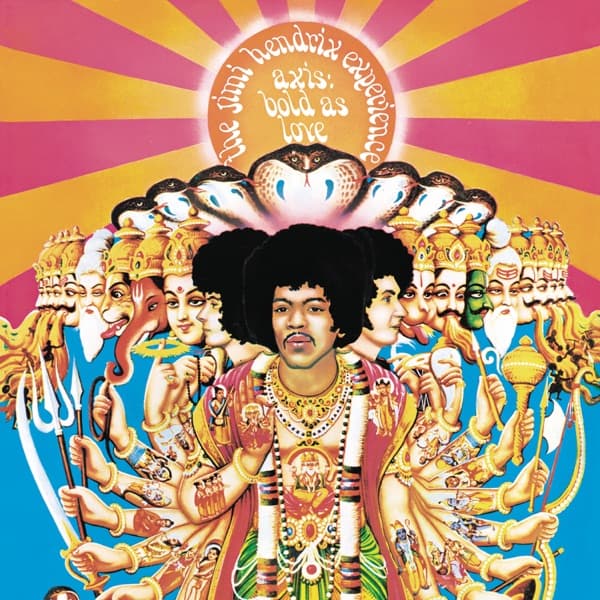

The first thing your eye finds is a face at rest inside a storm of arms. Jimi Hendrix sits dead-center, his dark halo of hair framed by a burst of sun, his expression calm while everything around him multiplies into chaos. To his left and right, painted smaller and turned inward, are Noel Redding and Mitch Mitchell, the other two of The Jimi Hendrix Experience. And spreading out from all three, like petals off a single flower, are a dozen serene many-armed deities crowned in gold, some green-skinned, some blue, an elephant head among them, a cobra rearing over the top of the sunburst. This is Axis: Bold as Love, and the men who made the music are wearing the bodies of gods.
Those bodies were not invented for them. The whole tableau began as a poster, a mass-produced Hindu devotional print titled Viraat Purushan-Vishnuroopam, bought in a London store by David King, art director for the UK Sunday Times magazine in the 1960s. Commissioned by Track Records co-founder Chris Stamp, King latched onto the Indian craze buzzing through the 1967 music scene and decided the band should not merely reference it but be absorbed into it, depicted as various forms of the Hindu deity Vishnu.
To pull it off, he needed the three real faces to sit convincingly among painted immortals. King hired Roger Law as a technical illustrator to paint the heads of Hendrix, Redding and Mitchell to match the style of the Hindu painting, working from a photo-portrait shot by Karl Ferris. Look closely and you can see the seam of that process: the three central heads have a rounded, photographic solidity, a warmth of skin and shadow that the flatter, more stylized deity faces around them do not. Their painted portraits were then superimposed onto the poster's three central figures, so that Hendrix, Redding and Mitchell literally replace the humans the print had once shown.
The palette is pure late-1967. A magenta and marigold sunburst radiates from behind the cobra's hood at the top, its rays fanning outward against a turquoise sky. The title curls in slim hand-lettered script inside a golden solar disc above Jimi's head: 'the jimi hendrix experience,' then 'axis: bold as love,' the words themselves halo-like. Gold jewelry drips across every chest, mandala-like medallions and beaded necklaces catching the light. The lower half dissolves into a dense weave of arms, tiny painted figures, and ornamental objects, a mace, a trident, a lotus, so packed that the eye keeps discovering new fragments the longer it lingers.
For all its saturated beauty, the man at its center wanted no part of it. The cover was built without Hendrix's approval, and when he saw it he said flatly that the three of them had 'nothing to do' with what was on the Axis sleeve. He felt the imagery misrepresented him: it would have been more appropriate, he argued, had it highlighted his Native American heritage rather than dressing him as a Hindu god. As recounted in the book Jimi Hendrix: The Ultimate Experience and quoted by Ultimate Classic Rock, his reaction was mixed rather than purely hostile: he first thought the design looked great, but felt they should have used an American Indian instead.
His discomfort has only grown more pointed with time. A Stereogum retrospective marking the album's 50th anniversary read the overlay of Vishnu onto Hendrix and his bandmates as cultural appropriation, while also acknowledging the flip side, the way such imagery could register as cultural validation for those who saw themselves in it. The tension sits right there on the cardboard: a genuinely gorgeous painting, and a musician insisting it was not his story to tell.
The controversy was not only philosophical. Decades after release, the album was banned in Malaysia, where the nation's censors seized copies, deciding that a cover showing the band as Vishnu could offend religious beliefs. That ban followed a Hindu association objecting to sales of posters based on King's sleeve illustration, the found devotional image having traveled full circle back into commerce and back into offense.
The rollout itself marked a deliberate change of strategy. Axis: Bold as Love was first released by Track Records in the UK on December 1, 1967, with Reprise Records handling the American release. Unlike the debut album, Track and Reprise decided there would be a single cover design shared across both the UK and US, a unified visual pitch aimed squarely at the moment's fascination with all things Indian.
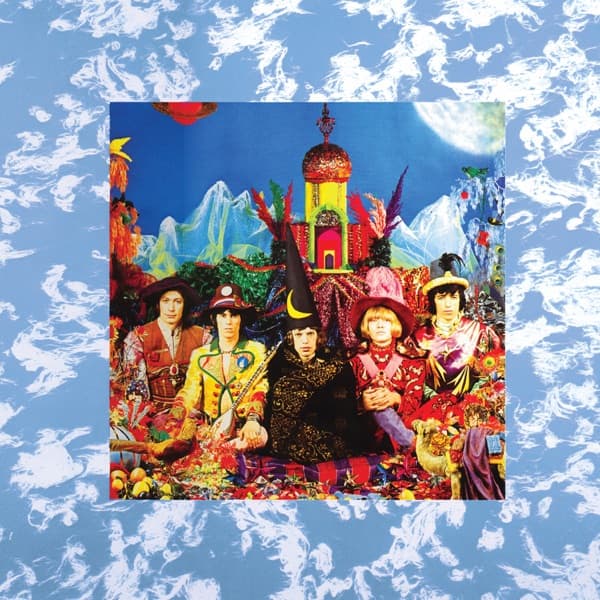
At the time, the reaction from critics leaned toward wonder. Melody Maker journalist Nick Jones praised it as a 'beautiful fold out package' and reached for the era's highest comparison, likening its concept to the Beatles' Sgt. Pepper's Lonely Hearts Club Band cover, another crowded, painted congregation of faces packed edge to edge. In both cases the sleeve was less a portrait than a population.
The music inside outlasted the argument over its wrapper. The album was certified platinum in the US by the RIAA and silver in the UK by the BPI, and in 2020 Rolling Stone placed it at number 92 on its list of the 500 Greatest Albums of All Time. Yet the cover remains a knot no accolade untangles: a store-bought sacred poster, a Sunday Times art director's psychedelic instinct, an illustrator's careful grafting of three faces onto three gods, and, at the calm center of all those multiplying arms, a man looking out who said none of it had anything to do with him.