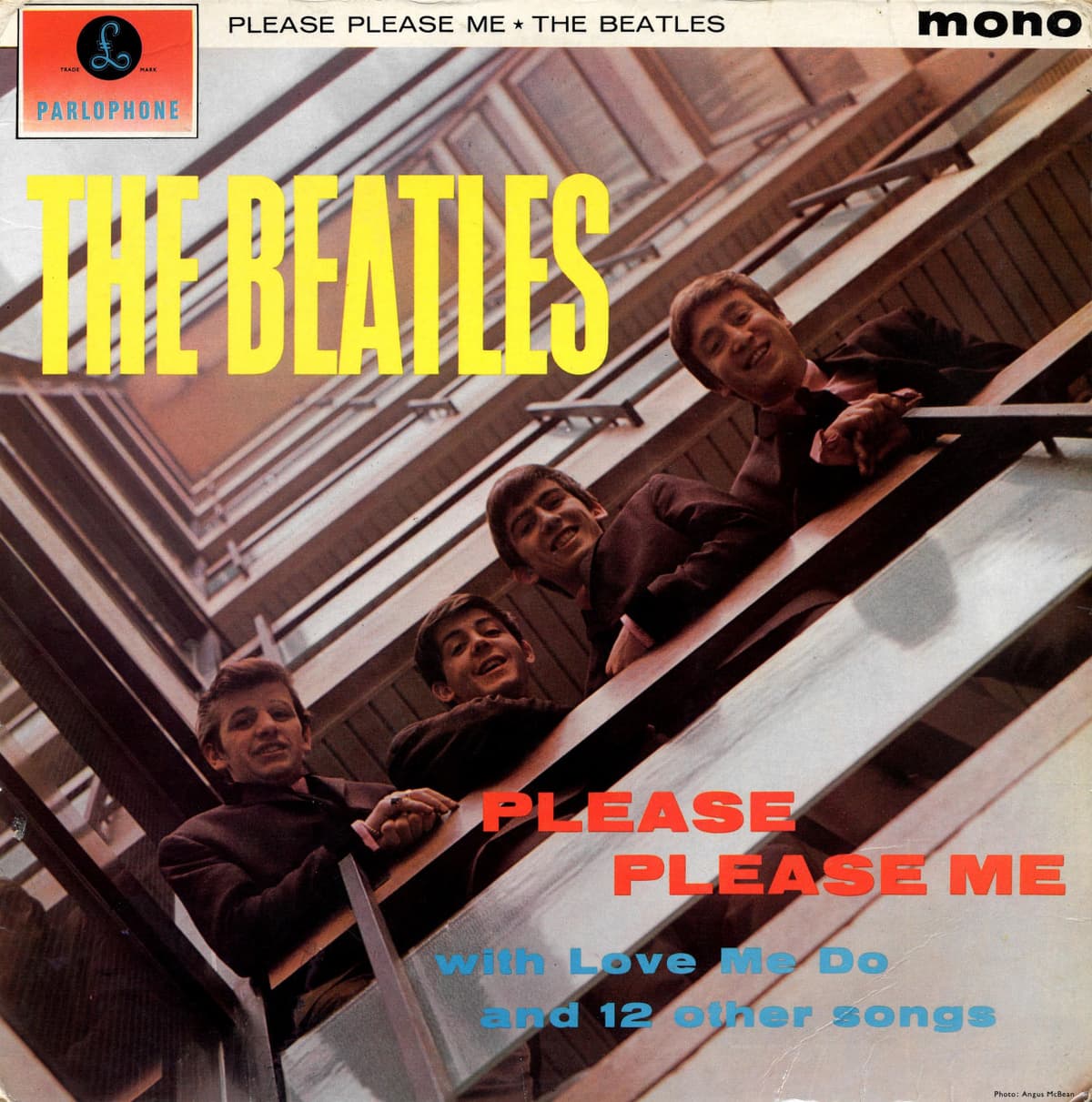
Four young men lean over an office balcony and look down at a photographer. There is no stage, no crowd, no instrument in sight. The building is the headquarters of the company that will release their record, and the camera is pointed upward from the stairwell below. The Beatles look almost amused by the arrangement: four faces lined up along a railing, smiling into the future without any idea how many times this picture will be seen.
The photographer was Angus McBean, a celebrated theatrical portraitist rather than a specialist in rock-band publicity. The location was EMI House at 20 Manchester Square in London. McBean later recalled noticing the stairwell as he entered the building and asking for the musicians to look over the banister. He had a portrait lens with him and, by his own account, lay on his back to make the picture. A setting that might have seemed too ordinary for a debut album became one of the most recognizable viewpoints in pop photography.
That upward angle does something more interesting than make the band look important. It puts the viewer beneath them, looking toward a group still very much at the beginning. The four men are crowded together, close enough that their faces form a single horizontal band above the diagonal architecture. Their expressions are open and youthful; the geometry of the office block gives the scene a crisp, almost corporate frame. It is a photograph of new stars taken inside the machinery of an established record company.
Please Please Me arrived in British shops on 22 March 1963. The album had been assembled at extraordinary speed. Ten of its fourteen tracks were recorded on 11 February, with the others drawn from the group's existing singles sessions. That economy is part of the record's character. Songs the band had sharpened in clubs and onstage were captured with little room for extended studio reinvention. The sleeve, similarly, has the air of a practical idea that happened to be exactly right.
George Martin, the producer, later remembered the photographic assignment as a hurried affair. In the recollection reproduced by Beatles historians, the call went out to McBean and the job was done quickly. What resulted was not a contrived scene of rock-and-roll rebellion. It was four musicians in suits, placed in the workplace of their new label, giving the camera their undivided attention.
The composition is often described simply as a balcony photograph, but the details are crucial. The converging lines of the building direct the eye toward the band. The railing supplies a boundary between the viewer and the subjects, yet their expressions seem to cross it. A strip of light around the upper figures separates them from the darker architectural interior. The viewer looks up, but the band looks straight back.
The lettering is equally direct. The group's name appears in prominent red at the top, with the album title and a note about their singles arranged below. This was a record intended to capitalize on the momentum of 'Please Please Me' and 'Love Me Do', and the packaging makes no attempt to disguise that commercial purpose. The photograph, however, outlived the marketing copy. It captured a sense of arrival more eloquently than a slogan could.
The idea of photographing the band at EMI House was not the first plan. Producer George Martin, who had worked with McBean on comedy record sleeves, initially proposed the insect house at London Zoo. Permission was refused. The eventual stairwell picture was not a grand concept commissioned months in advance; it was a practical answer to a rejected location that became inseparable from the band's history.
The precise date of the successful stairwell session has been reported differently. Some Beatles chronologies give 16 February 1963, while other histories and collectors' guides identify 5 March. The band's own official account says only early 1963. What is beyond doubt is the place, the photographer and the extraordinary economy of the result.
The sleeve also belongs to a particular moment in British pop history. In 1963, a long-playing record by a guitar group was not yet an inevitable cultural event. The Beatles had found an audience through singles and relentless live work. An album had to introduce them to buyers who might know the songs but not yet have a fixed picture of the four personalities behind them. McBean gave those buyers a collective portrait that was both orderly and full of possibility.
On the first British Parlophone issue, the sleeve was printed by Ernest J. Day & Co. and carried the photograph credit to McBean near the lower right edge. The upper-right mono designation identified the format. The earliest mono LPs had black Parlophone labels with gold lettering, an easily overlooked detail that helps distinguish the first issue from the later, more familiar black-and-yellow labels. The sleeve itself was front-laminated, its photograph wrapped around the board's edge. Tony Barrow wrote the back-cover notes. The record existed in mono and stereo editions, but they did not reach buyers simultaneously: the mono edition appeared with the March release, while the first stereo pressing followed in late April. The upper-right format lettering, printer credit and placement of the tiny Angus McBean photo credit varied across subsequent sleeve runs. Those manufacturing variations belong to the artifact's history, but the defining image is the same: four men looking over the edge.
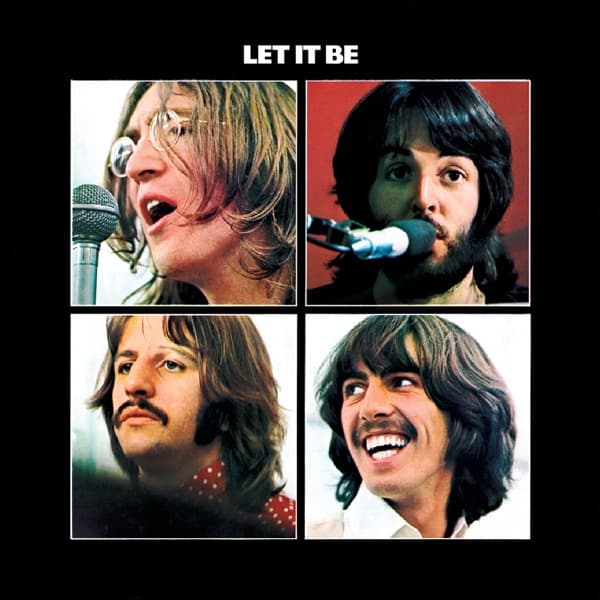
The image acquired a second life when the Beatles returned to EMI House in 1969 for a photograph echoing the original arrangement. The later picture was associated with plans for Get Back, but it found a lasting home on the 1973 compilations 1962–1966 and 1967–1970, paired with imagery from the earlier session.
The building itself did not survive. EMI eventually left Manchester Square, and the office block was demolished, although the company preserved the famous railing when it moved. A routine architectural feature had become an unlikely pop-cultural relic because McBean chose to point his camera toward it.
What makes Please Please Me so affecting is the absence of hindsight in the original frame. The musicians are not yet performing the role of 'the Beatles' as the world would come to understand it. They are young, suited, visibly together and looking down at a photographer who has found a good angle. The future is not in the picture. It is in the viewer's knowledge of everything that followed.