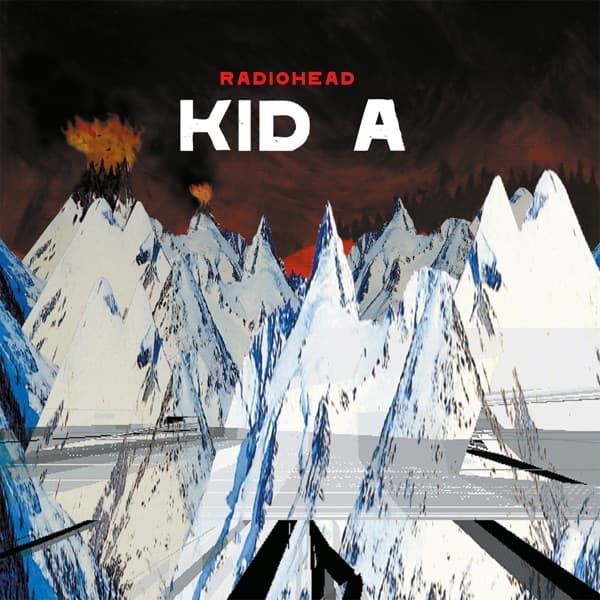
The composition is a wall of triangles. A jagged white range fills almost the entire frame, its peaks sharpened into fangs that crowd toward the viewer, so the eye is met by a barrier rather than invited into depth. The two flaming summits sit high and left, and the trail of orange flame and black smoke pulls the gaze up into the sky, which burns in a vertical gradient from deep brown at the top down to a livid red horizon. That red band behind the white peaks reads as heat trapped below cold, a landscape and a sky at war.
Colour does most of the emotional work. The snow is not clean white but stained with streaks of blue and flecks of black, and the fire's orange is the only warm note, isolated and ominous. Toward the foreground the whole picture appears to glitch and smear, pixels dragged downward as if a signal were breaking up, so the terrain seems to dissolve in front of you. The effect is of an image failing even as you look at it.
Those barbed triangles recur as a deliberate motif. Donwood called the mountains 'landscapes of power,' shapes meant to evoke tower blocks and pyramids and to hold a cataclysmic force existing in the landscape. Across this body of work the same menacing triangular form keeps returning, surfacing as peaks, as trees, as fangs in stark terrain, and it draws on German expressionism for its sense of dread. The image quotes that tradition of distorted, threatening scenery to make a mountain range feel like a threat rather than a view.
The typography answers the painting in kind. 'RADIOHEAD' sits small in red at the top, while 'KID A' is stamped huge in rough white capitals, their edges torn and uneven, as if the letters were cut from paper rather than set in type. The lettering has the same handmade violence as the canvases beneath it, refusing the polish of a normal title treatment.
Read as a whole, the picture works because its beauty and its horror are the same thing. A snowscape should be pristine and still; this one is scarred, burning and glitching into static, a place of power turned against itself. It is imagery critics have called chilling, prescient and apocalyptic, and the reason it lands is that nothing in it is comforting: the cold offers no refuge, the fire offers no warmth, and the ground itself is coming apart.