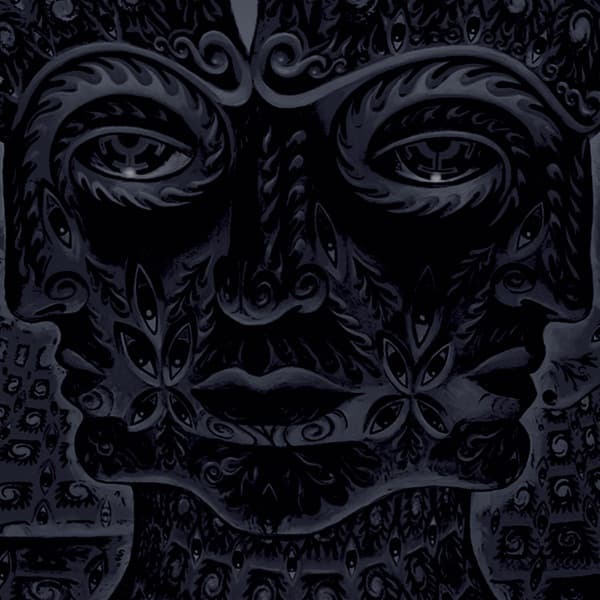
The palette is the first act of withholding. Everything is worked in blue-black and indigo, a saturation so deep it reads as monochrome until your eye adjusts and begins finding the cooler highlights sliding along a cheekbone, catching the wet gleam in an iris, tracing the ridge of a lip. There is no red, no gold, no relief anywhere in the frame. The face emerges out of the dark the way a face emerges out of sleep, half-formed, insisting on itself, and the absence of any warm tone keeps you working to resolve it.
What the eye lands on first is the eyes, and then more eyes. The two large primary eyes sit heavy-lidded and open, gazing out with a flat, patient calm. But the skin itself is not skin. It is a dense field of ornament: pointed leaf-shapes, almond forms, and tiny secondary eyes scattered across the brow, the cheeks, the jaw. The mustache and the flesh below the mouth bloom into petal-and-eye clusters. Every surface watches. This is the kind of packed, symmetrical, hallucinatory detailing that rewards the long stare and refuses the quick glance.
The composition is built on a vertical mirror. Down the center runs the axis where the two profiles meet, and the illustration flowers outward from it in near-perfect symmetry, left echoing right. That mirror line is also the seam the stereoscopic effect exploits: through the lenses the split profiles and swarming ornament resolve into one head hanging in space, so the symmetry is not just decorative but structural, the mechanism by which the flat image gains depth.
At the bottom corners the ornament shifts into something almost architectural, rows of small stacked forms like tiled walls or scaled armor closing off the frame. They anchor the softer facial forms above and keep the eye from spilling out of the composition.
The most radical choice is the typography, which is to say its total absence. There is no title, no band name, nothing to read but the illustration. Where most sleeves shout their identity across the top, this one withholds, and the silence only deepens the hush around the face. The one thing to read keeps changing depending on how you hold it, whether the glasses are on, how long you let your focus drift.
That is the trick of the thing. Most sleeves give you everything in a glance and then have nothing left to offer. This one gives you almost nothing at a glance, a dark blue mask you can barely parse, and then slowly, if you commit to it, opens into literal depth through a pair of paper lenses. The image behaves like a picture engineered to make you come back and look again: withholding, symmetrical, and impossible to take in all at once.