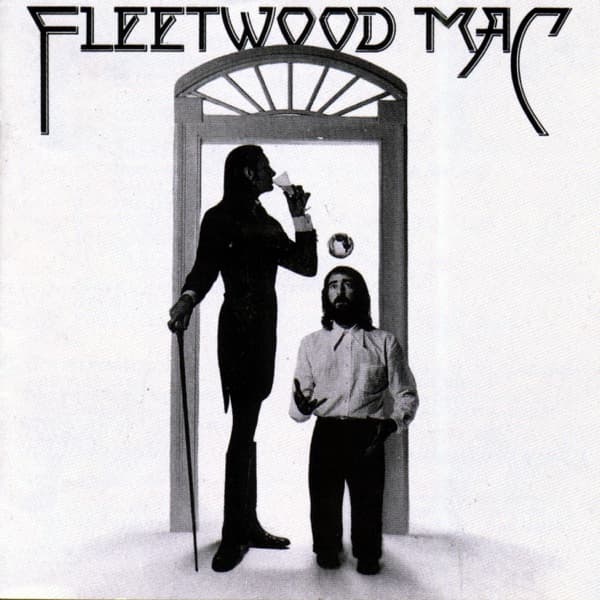
Look at how the frame is built. The doorway behind the two men is a real architectural element, complete with a fanned, sunburst transom window arching over the top, and it acts like a picture frame within the picture, boxing the figures and pushing them forward. The white surround swallows almost everything else, so there is nowhere for the eye to wander except back to the two men and the small dark object suspended between them. Above it all, the band's name runs across the top in tall, ornate lettering with pointed, gothic flourishes, the only decorative gesture in an otherwise austere composition.
The styling turns Fleetwood into a piece of theater. Dressed up, cane in one hand, champagne flute lifted to sip, he plays the part of some impossibly tall gentleman of leisure, his lean frame exaggerated by the tight dark costume against the bright ground. McVie, by contrast, is dressed plainly and stands still, and it is he who holds the crystal ball, appearing almost to juggle it or balance it in the air at his fingertips. The contrast between the flamboyant, elongated drummer and the grounded, ordinary-looking bassist gives the image a wry, slightly surreal wit.
The choice to show only two men is itself the meaning. Fleetwood Mac had a long habit of putting only some of the group on a sleeve rather than lining everyone up, and here that tradition narrows all the way down to the pair whose names endured through every earlier incarnation. The camera stays fixed on the two constants, the foundation, rather than any newer blood. In that sense the image is a hinge: the old foundation pictured at the threshold, standing quite literally in a doorway.
That crystal ball is more than a prop. Here it sits at the exact center of gravity between the two founders, a small sphere of possibility held up as if to ask what comes next. The sheer pale emptiness of the frame carries its own weight too: when a record shares its name with its own artist, the cover has to do the work of identification, and the drained, colorless void becomes the distinguishing mark. Reduced to two men, a doorway, a cane, a flute, and a floating glass sphere, the picture works because it says everything by showing almost nothing.