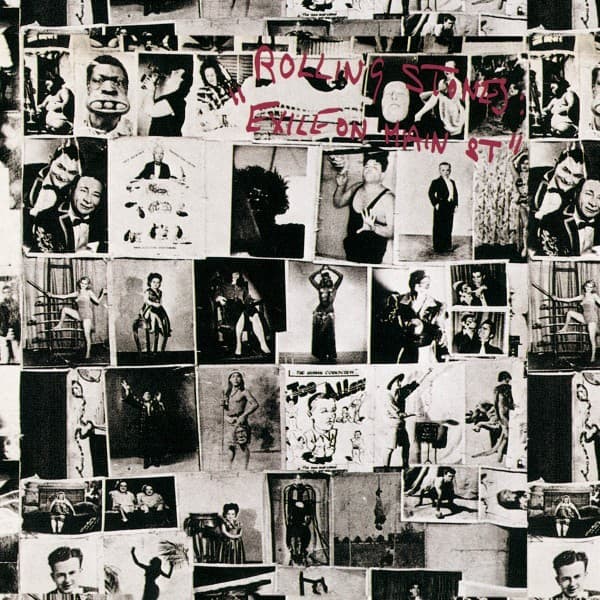

Few album covers fit their record as completely as Exile on Main St., but the front image was not made for the Rolling Stones. Robert Frank had photographed the scene years earlier: a wall crowded with pictures of sideshow performers, commonly titled Tattoo Parlor and associated with the body of work around The Americans. By 1972 it already belonged to Frank's documentary universe. The Stones made it theirs by placing that found image at the entrance to an album obsessed with American roots music, outsiders, drift and self-imposed exile.
Mick Jagger wanted a sleeve that did not look slick. The Stones had spent much of the album's mythology in France, where tax problems had pushed them out of Britain and Keith Richards' rented villa at Nellcôte became the chaotic base for recording. But the packaging was completed in Los Angeles, where the album was also finished and mixed. That L.A. phase brought together Frank, designer John Van Hamersveld and photographer Norman Seeff.
Frank was invited because his photographs already carried the kind of America the Stones were chasing: not postcard America, but diners, highways, outsiders, spectacle and people at the edge of respectable culture. He took Jagger into downtown Los Angeles and shot on and around Main Street, including the Skid Row area. He also filmed the band on Super 8. Those new images would feed the back cover and inner package. Yet when the front cover was being decided, the image everyone settled on was older: Frank's photograph of the sideshow-photo wall.
John Van Hamersveld later described the selection as almost startlingly direct. During meetings with Jagger, Keith Richards, Rolling Stones Records president Marshall Chess and others, another proposed cover was rejected. Frank's image was handed across, Jagger looked at it, and Van Hamersveld agreed. It became the cover. The choice immediately separated Exile from normal band photography. There is no heroic group portrait on the front and no clean emblem. The Stones enter the record through a crowd of strangers.
Van Hamersveld then built the surrounding package with deliberately basic means. He has described using photostats, tape, glue and physical paste-up. Jagger hand-lettered titles and credits with pen on paper sent to him by Van Hamersveld; those pieces were then pasted into the design. The roughness was not an accidental failure of production. It was the production language. Seams, handwritten marks and contact-sheet rhythms helped the sleeve feel handled, immediate and slightly unstable.
Norman Seeff's role was different but important. He photographed the band at Jagger's Bel Air residence in Los Angeles. Those images became the set of perforated postcards included with the original LP rather than replacing Frank's grittier front image. The package therefore holds two kinds of Rolling Stones photography at once: Seeff's purpose-made portraits and Frank's documentary fragments. The front chooses the latter.
Frank also contributed the film-strip and street imagery that extended the world of the cover. The Museum of Modern Art notes that the back cover includes a montage built from Super 8 footage of the Stones in downtown Los Angeles and in a Bel Air garden, alongside images connected to The Americans. This is where the title's Main St. acquires another layer: France may dominate the album's recording legend, but Los Angeles' Main Street is physically embedded in the sleeve.
One of the cover's best-known figures is Three Ball Charlie, shown with three balls held in his mouth. Other sideshow performers crowd the frame, each with their own histories, but the point of the image is not that they secretly stand for the Stones. The front works because it feels like a found wall of American spectacle. Later promotional designs sometimes mapped freak-show figures onto individual band members, but that should not be mistaken for the original photograph's literal meaning.
The complete package finally matches the record's sound through process rather than illustration. Exile is famously murky, layered, crowded and resistant to neat separation. The sleeve is too. Handwriting, tape, photographs from different times and different photographers, street footage and found imagery all coexist without being polished into uniformity. It feels assembled from a life already in progress.