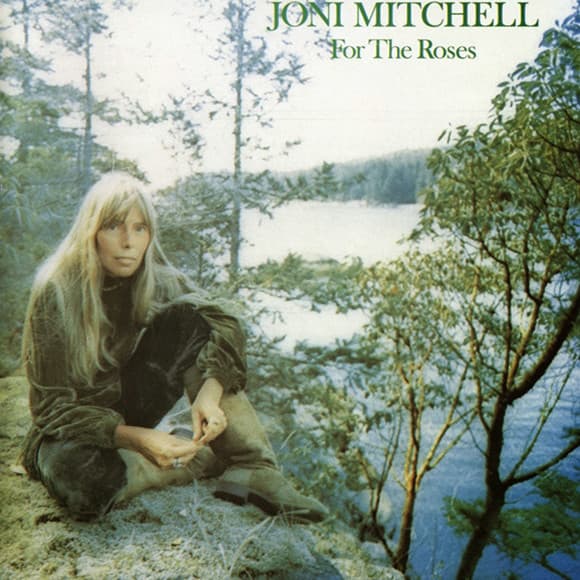

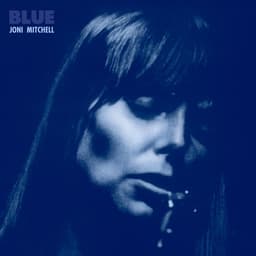
The cover of For the Roses looks like retreat. Joni Mitchell sits low among rocks and trees, dressed in green, almost absorbed into the landscape around her. After the blue-lit close-up that made Blue feel painfully intimate, this image gives her room to breathe. It is calm, natural and seemingly uncomplicated. It is also the end result of a much stranger argument about what an album cover was allowed to be.
Mitchell had another image in mind first. She drew a horse seen from behind with a bunch of roses emerging from its rear, an intentionally irreverent answer to the title track and to the machinery of the music business. The phrase 'for the roses' invokes the wreath awarded to a winning racehorse; Mitchell's song turns that image into a meditation on what happens when artists are celebrated, packaged and consumed. Her drawing made the joke blunt.
The record company wanted something else: Joni Mitchell's face on the cover. Mitchell's response was characteristically mischievous. If the label wanted an image of her, she had one. Photographer Joel Bernstein had taken a nude picture of Mitchell from behind, standing on rock and facing the water. Mitchell later recalled that the photograph had been made at Mt. Baldy outside Los Angeles and was conceived almost like a painting.
That photograph did not become the front either. Mitchell remembered being warned that a retail price sticker might wind up pasted across her backside. The nude was moved inside the gatefold. The front became the more restrained Bernstein portrait: Mitchell clothed, seated outdoors, surrounded by rock, branches, water and green. Anthony Hudson handled the album's art direction and design.
The compromise produced an unusually revealing package. From the outside, For the Roses presents escape: an artist sitting apart from the industry, visually folded into the natural world. Open the record and the tone changes. There is the nude photograph, and there is Mitchell's own artwork. The polished commercial object contains the evidence of the argument that produced it.
That tension belonged to the album itself. After Blue made Mitchell's private life a public subject, she withdrew from the center of the Los Angeles music scene and spent time at her property in British Columbia. For the Roses grew out of that period of distance. Its title song looks at acclaim with suspicion; elsewhere the record moves between relationships, fame, solitude and the possibility that stepping away might restore something fame had disturbed.
The front cover does not explain any of this. It does something better. Mitchell is present, satisfying the commercial demand for the artist to be visible, but she is not presented like a star. She is small within a larger environment, dressed in colors that nearly disappear into it. The industry got Joni Mitchell on the cover. Mitchell still managed to make the picture about getting away.
More than fifty years later, the image she originally wanted finally reached the front. For Record Store Day 2026, Rhino issued a limited edition using Mitchell's horse-and-roses drawing as the cover for the first time. What had once been rejected became the selling point of a collectible edition. The joke had taken more than half a century to complete.