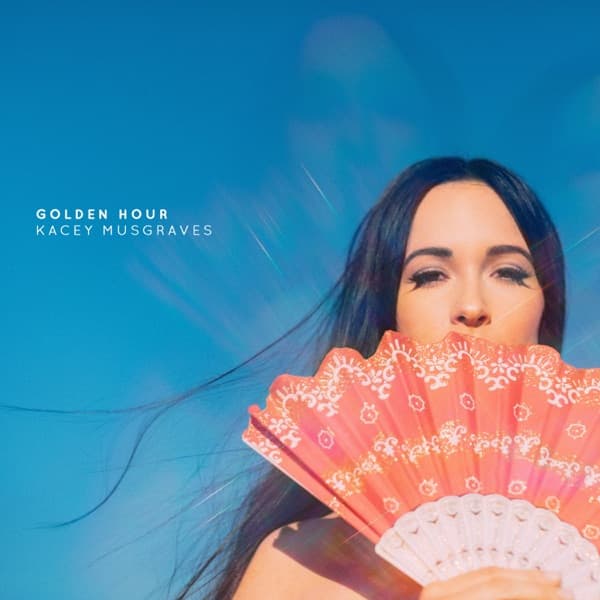
Start with the sky, because the picture makes you. It occupies nearly the whole frame, broken only by soft radial streaks of light near the top, as if the sun were sitting just out of view and blowing color across everything. That vast, saturated blue is the dominant compositional decision, and it does two things: it isolates the figure, and it fills the negative space with warmth and light rather than emptiness.
Against that expanse, Musgraves rises from the bottom edge, and her hair is the first sign of movement. It streams off to the left like ink dropped into water, a diagonal of motion that keeps an otherwise still, centered portrait from feeling static. The wind is visible, which is part of why the image feels caught rather than staged.
Then the fan, the true focal object. It is coral-pink, printed with a pale, lace-like pattern of scalloped arcs and floral filigree, its ribs fanning outward into a broad semicircle. Formally, it is a shape that answers the sky: a warm, patterned, human-made curve set against cool, empty blue, so the eye cannot help but land on it. Because it covers her mouth, the expressive burden shifts entirely upward, to the eyes and brows, which read clearly while everything below is withheld. The picture builds its meaning from that withholding.
The typography stays deliberately out of the way. Over on the left, floating in the blue, the title Golden Hour and the name Kacey Musgraves are set in a slim, widely spaced, all-caps sans serif, small and understated. There is no logo, no ornament, nothing shouting. The lettering lets the sky breathe and the fan pop, and it establishes the eye's path: you land first on the fan, travel up to her eyes, then drift left to read the words.
Color carries the interpretation. The pink pastel fan against saturated blue, softened by those light streaks, reads warmer and dreamier than a traditional country portrait, more atmosphere than twang. The palette signals a project about mood and light as much as place. This is the golden hour itself rendered as a feeling rather than a literal sunset, the whole frame lit as if from just outside it.
Put together, the composition leans figure and text against each other across an emptiness of blue, and the closeness of the crop, the wind in the hair, the half-covered face, all combine to read as intimacy. This is a person you feel you know rather than a styled icon, and the image works precisely because it hides half its subject while telling you everything about the light she is standing in.