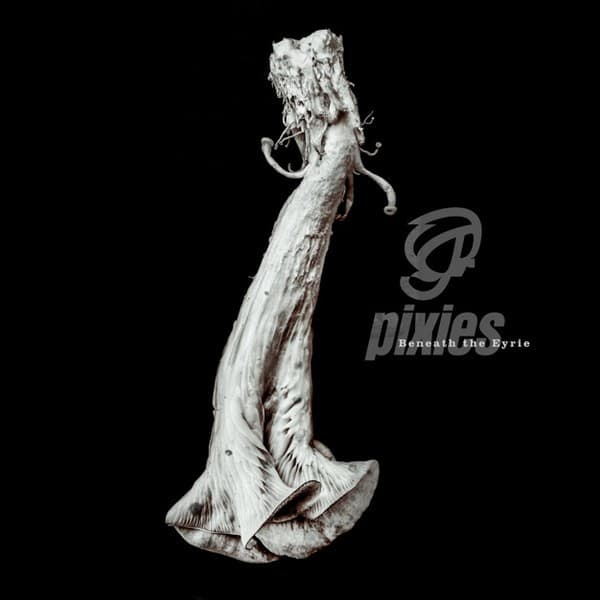

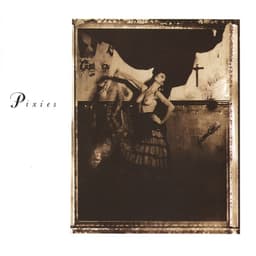
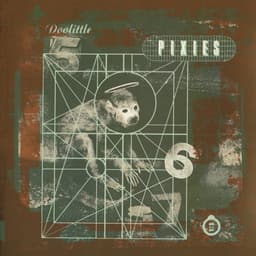
By 2019, a new Pixies sleeve designed around mystery was not a break with the band's visual history. It was a continuation of it. Beneath the Eyrie arrives as a dark square with a pale, strange form suspended against black, an image that feels bodily, mineral and sculptural without resolving cleanly into any one thing. That uncertainty is the point to preserve. The cover is powerful because it refuses to explain itself at a glance.
The original package credits are unusually important here. AllMusic lists Vaughan Oliver for art direction and design, Michael Speed for design, and Simon Larbalestier for photography. Those names connect Beneath the Eyrie to the visual language that had surrounded Pixies for decades: Oliver's art direction and Larbalestier's photography were central to some of the band's best-known sleeves, while Speed worked within the v23 design studio lineage. The 2019 cover therefore belongs to an established creative conversation rather than a generic late-career rebrand.
The album's title came from the place where the record was made. Pixies recorded at Dreamland Recording Studios, a converted church in the woods of upstate New York. In an interview with The Independent, drummer David Lovering remembered an overgrown nineteenth-century rail line behind the church and, visible through the woods, an enormous bald eagle's nest. That eyrie gave the album its title. The setting supplied more than a name: the band described Dreamland and the surrounding winter landscape as strange, old and naturally suited to the mood they were pursuing.
Black Francis has been unusually clear about that mood. Speaking to NME, he resisted the idea of a tightly plotted concept album but said the band intentionally allowed a gothic theme to guide the record. In another interview, he described 'gothic' as the improvisational word for the sessions: when something dark or uncanny appeared in the songs, they let it remain instead of smoothing it away. Beneath the Eyrie is therefore not a title imposed after the fact on an unrelated set of songs. Place, language and atmosphere were all feeding the same record.
That context changes how the cover reads. A less careful explanation might try to identify the pale object, assign it a fixed symbolism and turn the sleeve into a puzzle with a single answer. The available primary and reputable sources do not justify that. A stronger reading stays with what can actually be seen: an isolated light form in deep darkness, photographed so that scale and material are hard to judge. It behaves like an artifact found in the woods or a specimen lifted from a cabinet, but those are visual associations, not documented creator statements.
The ambiguity is consistent with Vaughan Oliver's broader approach to Pixies imagery. His work for the band rarely functioned as literal illustration of a song title. Instead, it established a parallel world around the music: tactile, photographic, sometimes sensual, sometimes unsettling, and often resistant to quick decoding. Beneath the Eyrie retains that strategy in a much more stripped-back composition. There is no band portrait, no explanatory landscape and very little visual noise. The eye has nowhere to go except toward the pale central shape.
Simon Larbalestier's photography is crucial to that effect. The image depends on texture and tonal contrast rather than narrative action. Against black, the object seems almost to emerge from nowhere. Its highlights reveal enough surface to make it physical while the surrounding darkness withholds context. That tension between evidence and uncertainty mirrors the album's own title: an eyrie is a real nest in a real landscape, yet the word sounds archaic and mythic enough to belong to a gothic story.
Michael Speed's design credit also deserves to remain visible rather than being collapsed into Oliver alone. The package credits make clear that Beneath the Eyrie was collaborative: Oliver handled art direction and design, Speed is separately credited with design, and Larbalestier supplied the photography. Treating the sleeve as simply 'a Vaughan Oliver cover' erases part of how the final object was made.
The release arrived on September 13, 2019 through Infectious/BMG. Pixies' own site announced the date in June and marked the album's release that September. Contemporary interviews around the record repeatedly returned to the Dreamland setting, the eagle's nest and the gothic atmosphere, giving the sleeve unusually strong contextual evidence even though its central object remains unexplained.
That combination is what makes the artwork useful to document. Beneath the Eyrie gives us solid answers about who made the package and what emotional world surrounded the record, while still leaving the central image open. The best cover histories do not fill every gap with certainty. Sometimes accuracy means preserving the mystery that the designers left intact.