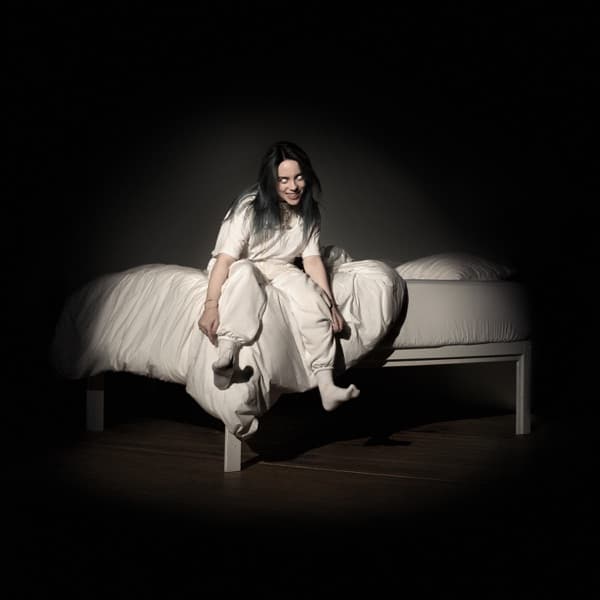


The first thing your eye finds is the smile, and it is wrong. Billie Eilish sits at the edge of a white bed, leaning slightly forward, and she is grinning, but there is no warmth in it. Her eyes should anchor the expression. Instead they refuse to. The pupils have been whited out, blank and gleaming, so the gaze reads as something staring through you rather than at you. It is the single detail that turns a girl in pajamas into an apparition.
Everything on this bed is pale and everything around it is swallowed by black. She wears a loose white outfit, and it flows into the white bedding so completely that her body and the mattress seem carved from the same material. White socks. Her socked feet dangling toward a wooden floor that is barely lit. Her dark hair falls in loose strands across her face, one of the few things breaking the whiteness. The bed itself sits on thin light-colored legs, floating in a void with no walls, no window, no room, just a pool of light and then nothing.
That light is the trick, and it was a deliberate one. Photographer Kenneth Cappello used no additional lighting for the shoot, so the finished image would feel as if a door had just cracked open and light was spilling into an otherwise pitch-black bedroom. You can read it in the shadows: the illumination arrives from the front and slightly above, leaving the floor and the far side of the bed to dissolve into darkness. The effect is that of catching something the instant it is exposed, a figure lit by an intruder who did not expect to find her awake and smiling.
The concept did not come from a stylist or an art director handed a brief. Eilish arrived with sketches she had drawn herself, drawings shaped by the album's themes of night terrors and lucid dreaming, and by her love of horror films, specifically The Babadook. That lineage is legible in every choice. The bed as a site of dread rather than rest. The dreamer who has become the monster. The moody, low-key atmosphere Cappello said he knew she wanted, engineered to feel real instead of staged.
The partnership behind the picture ran deeper than a single session. Cappello had photographed Eilish before, shooting the cover of her 2017 debut EP Don't Smile at Me, the yellow-background image with the red ladder. That is where the two first met. So the person framing her in this black void was not a stranger but a collaborator who had already helped define her visual world, now following her from a bright yellow backdrop into total darkness.
There is a strange biographical detail folded into the making of this image. The twelve-hour session took place in December, at a studio in Los Angeles, on Eilish's 17th birthday. A teenager spent the whole of her birthday sitting on a fake bed in the dark, holding an unsettling grin, her pupils whited out. The length of it, twelve full hours, speaks to how much care went into an image that looks almost casual, as though a photographer simply happened upon her.
The day did not end in exhaustion alone. The shoot culminated in a mini birthday party, and she was surprised with a custom blacked-out Dodge Challenger. It is a small, human coda to a photograph built on menace: the horror show wrapped, the cake came out, and there was a black muscle car waiting for the newly seventeen-year-old who had just spent her birthday impersonating a night terror.
When When We All Fall Asleep, Where Do We Go? arrived on March 29, 2019, released by Darkroom and Interscope in the United States and by Polydor in the United Kingdom, the cover was already familiar. Eilish had posted it to her Instagram, then followed by some 15 million people, before the album came out. The image had been living in phones and feeds for a while, which only sharpened its impact: an unsettling picture scaled down to a thumbnail, that grin and those blank eyes shrinking to fit a screen without losing their pull.
The sound the cover introduces matches its unease. The album has been described as pop, but the qualifiers pile up quickly: electropop, avant-pop, art pop, threaded with the textures of hip hop and industrial music. It is pop that keeps stepping into shadow, exactly like the photograph, where the familiar comfort of a bed is lit like a crime scene and the girl sitting on it looks like she has been waiting in the dark for you to open the door.
What holds the whole frame together is restraint. No busy typography competes with the figure. No color intrudes on the black-and-white scheme except the faint warmth of the wooden floor. The composition centers her low in the frame, small against the emptiness, so the surrounding darkness becomes a character in its own right, an entire unlit room implied by absence. You fill in the walls, the ceiling, the door that must have just opened. That is the quiet genius of shooting with a single natural-feeling light source: it hands the imagination the job of building the nightmare.
And so the cover works the way the best horror does, by withholding. It never shows you the room, never explains the smile, never lets you meet her eyes because there is nothing there to meet. A teenager drew these ideas on paper, a longtime collaborator lit them with almost nothing, and the result is a photograph you cannot quite look away from, precisely because part of you wants to.