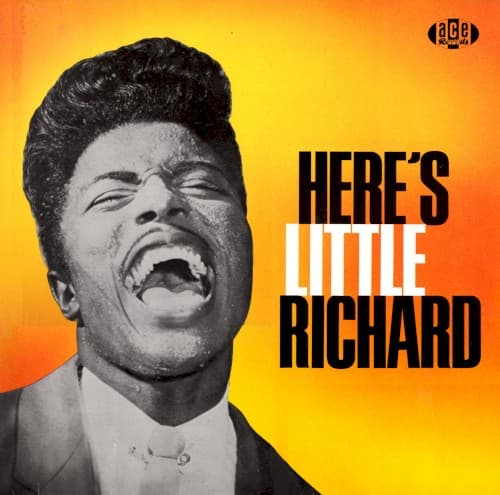
The composition splits cleanly down the middle. Little Richard's head occupies the left half in stark black and white, thrown sideways and caught in the middle of a sound, while the right half is given over to the type. That division does most of the work: face on one side, name on the other, with the eye drawn first to the open mouth, then swept up the diagonal of the tilted head, then across to the words.
Everything about the portrait insists on motion. The eyes are squeezed shut, the mouth flung open on a shout, the pompadour piled high and glossy above him. He is not posing so much as performing for a camera that happened to be there. The high contrast of the photograph flattens him into pure expression, all light and shadow, so that the image reads less as a likeness than as an emblem of a voice at full volume.
Colour supplies the heat the monochrome cannot. The background runs from deep tangerine at the edges to a near-white hot centre, a furnace gradient that throws the black-and-white portrait into sharp relief. Because the figure carries no colour of its own, the orange glow becomes the sound made visible, a wall of heat radiating out from behind the singer.
The typography is stacked in heavy black capitals reading HERE'S LITTLE RICHARD, climbing the right side of the frame. LITTLE is picked out in white so it punches forward against the orange while the surrounding words stay black, a small trick of contrast that keeps the three lines from sitting flat. Up in the corner sits the small circular Ace logo, the only other mark on the sleeve.
Read together, the choices point one way. The title is meant almost literally: here is the man, caught in the act. The shut eyes and open mouth turn a portrait into a performance, the hot gradient turns silence into noise, and the blunt one-two of face and name refuses any decoration that would soften it. It works because it withholds nothing and asks for nothing extra. The picture promises noise, joy, and a voice that refuses to be turned down, and it delivers that promise before a single track plays.