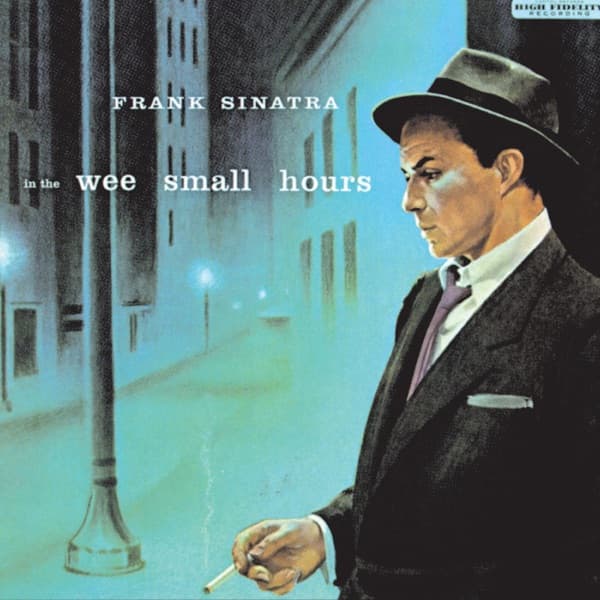
Look at the man on the corner. He is in profile, dressed in a dark suit and tie, a snap-brim fedora pushed back off his forehead rather than tipped low and cocky. A cigarette dangles from his lowered hand, its smoke barely a thread. Behind him a deserted street recedes into a wash of cold blue, lamps glowing along an empty sidewalk, buildings fading into the night. Everything tells you the hour is very late and the company has gone home.
That man is Frank Sinatra, and this is not a photograph. The image is a painting, and the choice matters. A painter can soak a whole street in blue-tinged light, can make the loneliness feel like weather. The fedora pushed back instead of worn at a rakish angle reads as resignation, even openness, a man who has stopped performing confidence. The composition borrows the language of film noir poster art and the lurid paperback covers of hardboiled pulp fiction: solitary figure, menacing emptiness, a city that does not care.
The picture was built to set the mood for the music inside, and the music was something new. In the Wee Small Hours arrived on Capitol Records on April 25, 1955, and is widely counted among the first concept albums, its songs sequenced thematically around loneliness, lost love and heartbreak. This was not a grab-bag of singles. It was a single emotional narrative, played out across a full sitting, and the cover is its establishing shot.
The gamble paid off. The album climbed to number 2 on the Billboard 200 and held on for eighteen weeks, Sinatra's highest-charting record since Songs by Sinatra back in 1947. It also helped push the 12-inch vinyl LP into the mainstream and proved that a pop album could carry a coherent thematic story from first track to last, an idea that would ripple outward to artists as different as Tom Waits, Marvin Gaye, Elvis Costello and B.B. King.
That lonely blue street kept finding new lives. In Cameron Crowe's 2001 film Vanilla Sky, the cover appears in the final scene, as Tom Cruise's David Aames steps off a building and watches his life flash past. The image of a man alone at the edge of the night fit perfectly into a story about falling. The pose proved just as portable: in 2007 Kurt Elling struck exactly Sinatra's stance for the cover of Nightmoves, an album that also includes a recording of 'In the Wee Small Hours of the Morning.'
Not every tribute was reverent. The Subsonics' 1993 album Good Violence repainted the scene faithfully, the same suit, the same hat, the same haunted street, then swapped the cigarette for a syringe, turning Sinatra's quiet ache into something darker and more pointed. It is proof of how instantly readable the original is: change one object in his hand and the whole meaning shifts.
There is a footnote worth knowing if you go hunting through crates. A later abridged reissue from 1962-1963, pressed in Duophonic sound, wore different cover art entirely, a photograph credited to William Claxton instead of the painted street scene. So the man under the streetlamp is not guaranteed when you flip through the bins. But when you do find him, cigarette down, hat back, the blue closing in around an empty block, you are looking at the very first frame of a story the cover sets in motion before he sings a note.