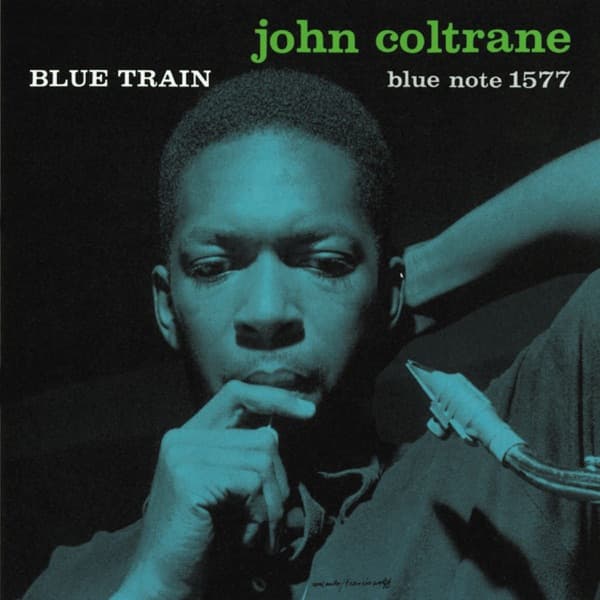
The whole cover is drowned in a single hue: a cold teal-blue that coats skin, shirt, and metal alike, collapsing the range of natural color into one temperature. This is not a photograph tinted for decoration; it is a photograph rethought as a monochrome field. Because everything shares the same blue, the eye stops reading the image as a snapshot of a room and starts reading it as a mood, a state of mind rendered as a color. The title's word BLUE stops being a name and becomes a literal instruction the picture obeys.
Composition places Coltrane just off-center, his head filling the upper two-thirds of the frame, his lowered eyes and the bridge of his nose forming the brightest, most modelled zone. The eye enters at that lit forehead, slides down the shadowed cheek, and arrives at the hand pressed to the mouth. That gesture is the hinge of the whole image. The fingers curl against the lips, sealing the mouth of a man whose instrument is played with the mouth. A saxophonist caught not blowing but withholding, the horn silent, the breath held: the cover freezes the pause before sound rather than the sound itself, which is why it reads as thought made visible.
Light is handled as sculpture. A single source rakes across the face from the upper right, catching the brow and the ridge of the nose while letting the far side of the face fall into near-black. This chiaroscuro carves the head out of the dark the way a Baroque portrait pulls a face from shadow, and it means the picture is asking to be taken as a study of interiority, not a publicity smile. Nothing about the lighting is flattering in the commercial sense; it is investigative, probing the planes of the face for evidence of concentration.
On the right edge, easily missed, the curved neck and mouthpiece of the saxophone rise into the frame, catching a hard highlight so that the metal glows brighter than anything else in the image. It is the one object with real specular shine, and its brightness pulls a second beat of attention after the face. The instrument is present but incidental, pushed to the margin, half out of frame: the man matters more than the tool, yet the tool refuses to disappear entirely, a reminder of what those sealed lips are built to do.
The cropping is aggressive and deliberate. Coltrane's shoulders are cut by the bottom edge, his arm cut by the left, the horn cut by the right. We are given no full figure, no context of studio or stage, only a close, almost claustrophobic proximity to the head and hand. This tight framing forces intimacy; we are inside his personal space, near enough to see the sweat-sheen on the forehead, and that nearness is what makes the introspection feel eavesdropped rather than posed.
The background is a flat, unreadable dark on the left, deepening to black in the corners. It is negative space that does no describing, and that emptiness is functional: it isolates the figure, denies the eye any escape route, and turns the whole left third into a well of shadow that the type can float against. The darkness also lets the blue of the skin read as luminous by contrast, as though the man were lit from within the color rather than by any lamp.
Typography sits in three weightless clusters against that dark. The artist's name runs across the top right in lowercase, set in a warm green that is the only real chromatic break from the blue, a small complementary jolt that keeps the cover from being merely monotone. BLUE TRAIN appears upper left in clean white capitals, compact and blunt, the harder counterweight to the soft lowercase name. Down in the lower right, blue note 1577 sits small and quiet, catalogue number treated as design element. The letters never crowd the face; they occupy the dead air the photograph leaves at top and sides, so image and text share the rectangle without competing. The restraint of the lettering, its refusal to shout, matches the sealed mouth: this is a cover that speaks softly on purpose.
At the very bottom edge, a handwritten signature credits the photograph, a small human mark left in the emulsion that quietly insists the picture is authored, an image made by an eye rather than grabbed at random.
Read as a whole, the cover argues that seriousness has a look, and that look is cool, close, and blue. Everything cooperates toward it: the single cold hue, the withheld breath, the shadow eating half the face, the horn banished to the margin, the lettering kept to a murmur. The image says that the music inside is contemplative and self-searching before it is anything else, and it earns that claim by refusing every easy gesture, no color, no smile, no action, only a man and his own thought held at the point just before he plays.