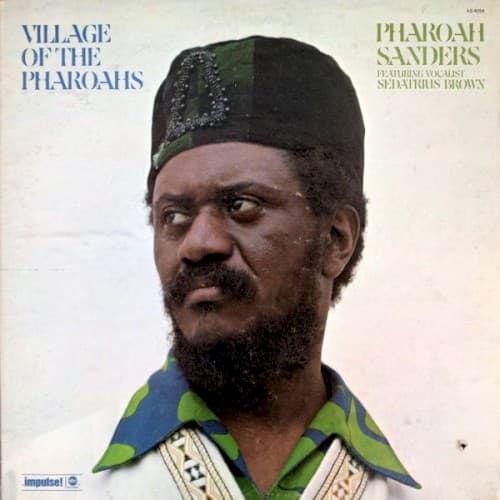
The composition is a tight head-and-shoulders portrait, cropped so closely that the top of the cap and the base of the collar almost touch the edges of the square. This scale forces intimacy: there is no environment, no props, only the man. The eye lands first on the face, then travels up to the embroidered cap and down to the patterned shirt, before circling back to the eyes, which pull the gaze off to the right and out of frame.
That sideways look is the single most active choice in an otherwise static image. Sanders is not addressing the viewer; he is turned partly away, absorbed. The refusal of eye contact converts a straightforward publicity portrait into something more withdrawn and interior, a man caught mid-thought rather than posing.
Colour does the emotional work against a background of near-total white. The warm brown of his skin and the dark of his beard anchor the center, while the cap and shirt introduce the only saturated notes: greens and a flash of blue, broken by the pale embroidery running up the front of the garment and around the crown of the cap. Set against the empty white, these colours read as deliberate signals of identity and dress rather than decoration, and the negative space keeps them from competing for attention. The white also flattens depth, pushing the figure forward like a portrait cut from its surroundings.
Light is even and frontal, modelling the face gently without drama or shadow-play. This softness suits the stillness; nothing is theatrical. The effect is closer to a formal, respectful likeness than to a glamour shot.
The typography sits in the two upper corners and stays out of the figure's way. At top left, the title is stacked in a pale, cream serif across several lines; at top right, the artist's name is set large, with a smaller line crediting a featured vocalist, Sedatrius Brown, beneath it. The lettering's colour echoes the embroidery, tying text to garment. Down in the lower left corner sits the small Impulse! logo, the only mark of the label's presence.
The focal path is therefore simple and controlled: face, then the cultural markers of cap and shirt, then the framing text, then back to the eyes. The whole image resolves into a reading of gravity. There is no whimsy here, no scene to narrate; the meaning lives entirely in the expression and dress of one man.
That gravity is the point. PopMatters writer Sean Murphy observed that a glance at any of Sanders' unsmiling covers from this period signals the intense, uncompromising ride of the music inside. This sleeve makes that legible in a single face: the seriousness of the gaze and the plainness of the presentation prepare the listener for a music that will be demanding rather than ingratiating. The cap and embroidered shirt locate that seriousness in a specific cultural identity, so the portrait reads not just as a musician but as a man presenting himself on his own terms. The picture works because it withholds; the averted eyes and empty background leave the viewer with a presence that feels both immediate and unreachable.