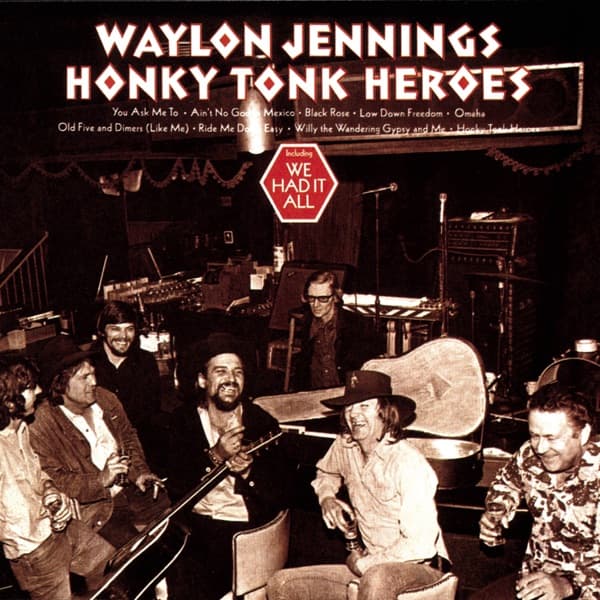
The image is drenched in a single warm brown, a sepia-and-amber wash that turns the whole scene into something between an old photograph and a memory. That tonality does two things at once: it flattens the crowd into a unified glow and lets it read as remembered rather than staged. The light pools on faces and glass and the curve of the guitar, letting the edges fall into shadow, so the eye is drawn to the warmth at the center and the clutter dissolves into the dark.
Behind the men you can pick out the fittings of a working room: amplifiers stacked at the right, cables, what looks like recording or stage gear, a piano lid, and strings of small lights or garland draped along the upper walls. Nothing is styled or sterile. It reads as a real place, lived-in and a little chaotic, the kind of room where the drinks do not stop for a camera. That background does not decorate the figures so much as authenticate them.
The composition rewards a second look. The figures form a rough arc across the bottom, faces turned inward toward one another rather than out at the viewer, so we feel like guests who wandered in rather than the intended audience. Only the bearded man with the guitar meets our gaze, an anchor amid the motion. Above them the empty upper third gives the crowd room to breathe and lets the words announce the celebration below. The loose, unguarded body language, the arms slung around shoulders, the heads thrown back, carries the record's attitude without a caption.
At the top, the typography plays it straight and bold. WAYLON JENNINGS and HONKY TONK HEROES run in two clean lines of tall white capitals across the warm ground, framed by a thin outlined border like a hand-lettered sign. Beneath the title the songs are listed in small type, a full running order stretching across two lines: You Ask Me To, Ain't No God in Mexico, Black Rose, Low Down Freedom, Omaha, Old Five and Dimers (Like Me), Ride Me Down Easy, Willy the Wandering Gypsy and Me, and the title track itself. Tucked between the type and the crowd sits a small red badge shaped like a road sign, announcing that the album includes We Had It All. It is the one splash of true color on an otherwise monochrome sleeve, and it pulls the eye like a stop sign, sitting almost dead center as a deliberate pin holding the gaze between name and revelry.
Understood as a whole, the cover stops being just a party photo and becomes a portrait of independence. The men crowded onto that couch are a band gathered in a bar that stands in for the whole ethos of the music: unpolished, communal, loud, and made on its own terms. There is no orchestral pretense, no house-band uniformity. The plainspoken white capitals up top, the warmth of the sepia, the drinks within arm's reach and the unforced laughter all say the same thing, that the man made this his way. Country music in 1973 did not usually look like this; it looked composed, respectable, sometimes stiff. Here a barroom is dared to be the whole point, and what a tidier hand might have cleaned up is put front and center.