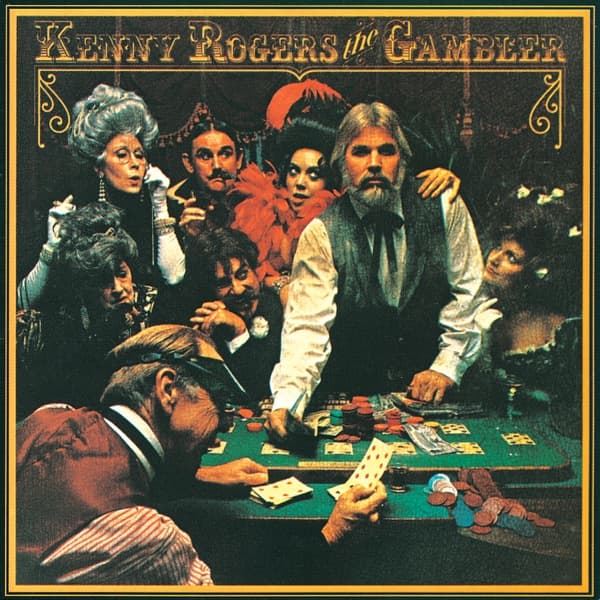
The composition is built around a single anchor. Rogers occupies the vertical center behind the green felt table, and every other element bends inward toward him. He is the still point in a frame otherwise crowded with movement, and his direct gaze out of the picture fixes the viewer while the supporting cast looks sideways, down, or at each other. That contrast, one steady stare against a swirl of averted glances, is what does the compositional work: the eye is pulled first to the chaos, then settled on the man at the middle.
His costume reads plainly against the busier figures around him. He wears a gray waistcoat over a white shirt with the sleeves pushed up and a loose dark neck-tie, one hand resting flat on the felt near a spray of dealt cards. Poker chips rise in red, blue, and cream columns beside a fanned-out deck. The tabletop glows that unmistakable casino green and is littered with the debris of a game in progress, a surface that tells you the hand is already underway.
Around and behind him, the picture becomes a tableau of hustlers and swells. At the upper left a powdered dowager with gray curls piled high drips with pearl earrings and holds a long white glove to her cheek in mock horror. A mustachioed dandy peers over a shoulder. A woman in a red feathered gown leans in close, her dark hair swept up dramatically. Lower in the frame, half-lit faces crowd the edges: a man with a scarred, leering grin, a woman emerging from shadow on the right. In the foreground, seen from behind, a hunched player in a striped visor and rust-colored coat holds his cards low, the back of his balding head turned to us. That turned back is a deliberate device, closing off the near edge of the table and pushing the viewer into the role of a fellow player at the game.
The lighting is theatrical and golden, warm lamplight falling on the central figures while the corners drop into shadow. The tonality is rich and low, closer to lamplit interior than studio flat, and the mood it builds is equal parts humor and menace. This is where the picture earns the comparison to a crowded gambling hall out of the 1800s, almost reading like a Renaissance painting in the way it stacks faces in receding planes of light and dark.
The typography completes the fiction. At the top the title runs across in ornate gold serif lettering with curling flourishes at the corners, KENNY ROGERS and the GAMBLER, all Victorian filigree and gilt. A thin gold border frames and seals the whole image like a saloon poster, matching the costumes and the card-table world below it. The type does not sit apart from the scene; it belongs to the same period pastiche.
What makes the image cohere is how completely it commits to its fiction. Nothing here signals a recording star posing in a studio. The pearls, the powdered wig, the red feathers, the visor, the chips, and the dealt cards all build a single world, and Rogers stands at the heart of it letting the drama swirl around him. The persuasive detail is not any prop but that steady, knowing gaze. You read the picture as a story with a protagonist, and the protagonist is a gambler who already knows how the hand ends.