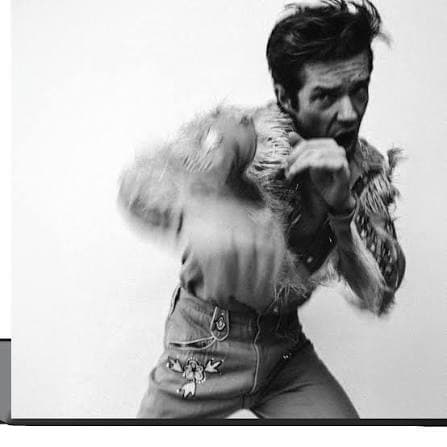

Brandon Flowers looks like he is about to hit you.
That is the first surprise of the THRASHER cover. After eleven years without a solo album, Flowers could have returned with something stately: a Utah landscape, an old car, a carefully posed cowboy portrait. Instead, photographer Chris Phelps caught him moving. Flowers leans into the frame with one arm sweeping across his body, his hair loose and the long fringe of his Western shirt flying around him.
It is funny, a little confrontational and immediately alive. More importantly, it tells the story of the record before a note plays.
THRASHER is Flowers returning to music that was around him long before The Killers existed. Growing up in and around Nephi, Utah, he heard the country and Western records his father loved. Flowers has said that he drifted away from that music when he was younger, only to find his way back to it as he got older. By the time he made THRASHER, country was not some new direction he had discovered. It was something familiar waiting for him.
That makes the clothing on the cover more interesting than simple cowboy styling. The embroidered trousers, ornate shirt and extravagant fringe make the country connection obvious, but Phelps does not photograph Flowers as though he is modeling them. The clothes are moving with him. The fringe shoots outward as his body turns, transforming the shirt into part of the action.
There is another layer to the homecoming. The Killers had already gone back to Utah on Pressure Machine, the band's 2021 album built around stories from Nephi. But Flowers later described THRASHER as even more personal. Pressure Machine looked at the town and the people who inhabited it. This time, he wanted to move inward, toward his own family, friends and memories.
The cover follows him there without showing Nephi at all.
There are no mountains, highways, ranches or small-town landmarks behind him. The background is nearly empty. Instead of using Utah as scenery, the photograph puts all of that history onto Flowers himself. The Western clothes carry one part of it. His body language carries another. He is not standing in front of his past. He is wearing it and moving through it.
Warren Fu, credited with the album's artwork and creative direction, was a natural person to help Flowers make that transition visually. Fu was not arriving cold to the assignment. He had worked with Flowers before, including directing the video for "Still Want You" during The Desired Effect era, and has a long history with The Killers. He understood the polished, theatrical world Flowers was coming from.
Chris Phelps brought a different but complementary vocabulary. His photography portfolio moves comfortably between rock and country culture. Alongside work involving Flowers and The Killers are artists such as Willie Nelson, Tanya Tucker, Sturgill Simpson, Margo Price and Colter Wall, as well as Western brands. Phelps did not have to manufacture the visual language THRASHER needed. He was already fluent in it.
The result is a cover that never quite settles into either world. Flowers is dressed like a country singer, but he moves like a rock frontman.
Even the decision to use black and white helps. In color, the embroidery and fringe might have dominated the picture. Without it, you notice texture and movement first: the pale shirt against the background, the dark decoration running across it, the blur of Flowers' arm, the strands of fringe thrown into the air. The photograph feels more immediate than decorative.
That same preference for immediacy shaped the album itself. Flowers recorded at Nashville's historic RCA Studio A with producers Shawn Everett and Jonathan Rado and musicians steeped in country music, including David Rawlings, Bruce Bouton and Charlie McCoy. Accounts of the sessions describe the players working live in the room, running songs only a handful of times until a performance became the take.
Flowers compared the feeling to the early days of The Killers.
Seen in that context, the cover's motion feels especially appropriate. THRASHER was not supposed to look like a man carefully trying on a genre. The record came from Flowers reconnecting with music he remembered, surrounding himself with musicians who could play it instinctively and trying to capture something before it became overworked. Phelps' photograph does much the same thing in a single frame.
The story also continues after the front cover. The physical LP was issued as a gatefold with an eight-page booklet and printed inner sleeve, turning Fu's creative direction into a package rather than a streaming thumbnail. A separate white-label edition was hand-stamped and hand-numbered. Paul Lane is credited with package production, while the broader visual credits include styling by Britt McCamey.
Those details matter because THRASHER belongs to a long tradition of records whose identity is bigger than the square on the front. The cover gets your attention with one strange, kinetic photograph; the physical edition gives that world room to expand.
Flowers has spent most of his career building versions of the American West into his music. With The Killers, that often meant Las Vegas: neon, casinos, desert highways, glamour and emptiness existing side by side. Pressure Machine traded Las Vegas for Nephi and looked closely at the town where he spent formative years.
THRASHER makes the geography smaller still.
This time the road leads back to his father's records, his family and the music that filled the car when he was a kid. That is why the cover works so well without showing a landscape. The place Flowers is returning to is not really Utah.
It is memory.
And on the cover, he is not standing still long enough for it to become nostalgia.