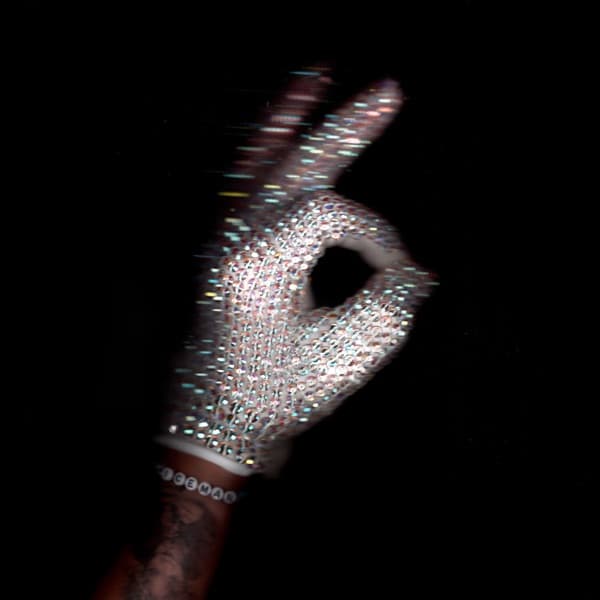
The picture is built on withholding. Against a total black field, a single gloved hand rises with no body attached, no printed name, no title anywhere in the frame. For an artist whose brand has long been his own likeness, refusing the face is the boldest choice on the cover, and it forces every ounce of meaning into a single gesture and a single object.
That object is the glove. Covered head to knuckle in sequins and rhinestones, it reads immediately as a reference to Michael Jackson's bejewelled glove. The reading is not subtle and is not meant to be. Raising a Jackson glove is a claim of lineage, a way of standing in the same light without printing a word of explanation.
The light itself is the medium. The rhinestones scatter tiny points of blue, gold and white, and because the hand is isolated in the void, those reflections are the only information the eye receives. Then the technique complicates it: the fingertips are blurred, motion-smeared, streaking the sparkle into little comet trails, as though the shutter caught the hand mid-move. That blur keeps the image from feeling like a static product shot and gives it a flickering, almost unstable quality.
The gesture is deliberately doubled. It is the universal 'okay' sign, and it can equally be read as a '6'. The composition leans on that ambiguity. Because the hand is cropped tight and isolated, the eye keeps circling the ring formed by thumb and forefinger, and the negative space in the middle glows faintly from all the reflected light around its edge. The focal path is a loop, not a line.
Lower in the frame the image turns personal. Around the wrist sits a small elastic band strung with lettered beads spelling ICEMAN, the kind of friendship bracelet fans traded by the thousand during Taylor Swift's Eras Tour. It is a strange, funny collision: one hand reaching back to the King of Pop, the wrist winking at stadium-pop fan culture. Just below the bracelet, where the glove ends and bare skin begins, you can make out ink: a tattoo of Drake's mother, Sandi Graham. So the black field is hiding a body after all, and the one sliver it permits us to see carries his mother's portrait.
Read as a whole, the cover works because it is legible and layered at once. A single glowing symbol on a void announces a bid for pop-royalty stature, while the beaded bracelet and the maternal tattoo smuggle in intimacy and a touch of the absurd. It is a picture engineered to be understood instantly, yet it rewards the second look, when the meme-ready clarity gives way to the person underneath the glove.