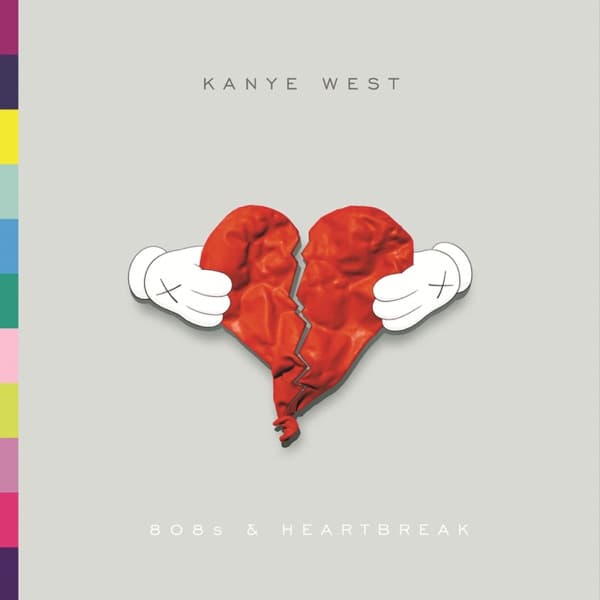
The restraint is total. West's designers pare the sleeve down to one object on an empty ground, and that emptiness is the argument: a soft, dove-grey field so neutral it reads as silence, forcing the eye to the only warm thing in the frame. Against that muted plane the red balloon becomes unavoidable, and its redness is not the flat red of a Valentine but the shine of a real inflated skin, photographed with enough clarity that you can trace every wrinkle.
The balloon's form does the emotional work. In the familiar heart shape you expect plump buoyancy; instead the two lobes crease and go slack, a jagged split runs down the center like a failed seam, and the bottom collapses into a pinched, tied-off knot. The eye travels down the shape the way air travels out of it, from the still-rounded top toward that deflating point. This is a heart that was once full, now visibly emptying.
Flanking it, a pair of white cartoon hands marked with small X's grasp the balloon from either side. Their flat, drawn quality sits oddly against the photographic realism of the heart, a gentle wrongness that keeps the image from tipping into pure sentiment. They hold, but they cannot re-inflate.
The typography whispers rather than shouts. Above the balloon, in thin, widely spaced grey capitals, the name KANYE WEST is so understated it nearly dissolves into the background; below, in the same delicate letterspaced type, sits the title 808s & HEARTBREAK. For an artist whose earlier covers leaned on maximalism and spectacle, this hush is its own kind of statement, everything ceding attention to the wilting red shape.
Then there is the strip. Running down the entire left edge is a vertical column of small color blocks, a stacked spectrum of purples, blues, yellows, greens, pinks and reds, like a paint chart or a set of equalizer bands frozen mid-song. Against the grey plane and the lonely red heart, this ribbon is the only place the cover lets itself feel electronic, playful, synthetic. It reads almost like a nod to the machinery inside, the drum machine and the tuned-up vocals, a bright seam of color at the edge like a heartbeat monitor that hasn't flatlined yet.
That split personality is the whole meaning. A sterile grey plane and a rainbow of digital color surround a hand-photographed heart giving up its breath, and the title names the same two poles: the 808 drum machine and the human wound. The picture doesn't illustrate heartbreak so much as embody it. It holds grief comfortably, a shape meant to celebrate love, deflated, and its genius is how little it does to get there. You look at it and understand the mood before a single 808 hits.