My Beautiful Dark Twisted Fantasy was released on November 22, 2010, through Def Jam Recordings and Roc-A-Fella Records. Critics heard it as maximalist hip-hop laced with soul, baroque, electro and symphonic sweep, and catalog listings give its genres as hip-hop, progressive rap and rap opera. Much of it came together at Honolulu's Avex Recording Studio, where West retreated into a self-imposed exile after the 2009 Taylor Swift VMA incident. Out of that distance came a record loud enough to fill a stadium.
For the visuals, West commissioned George Condo, a New York-based painter known for cubist-inspired work who, at the time, was preparing a major retrospective at the New Museum. Condo, by his own account, was old-school about rap and found West new to him. West phoned him from Hawaii, then visited his studio for hours; at their first meeting West blasted the single 'Power,' and Condo immediately began imagining mythological creatures, volcanic landscapes and pieces of Macbeth.
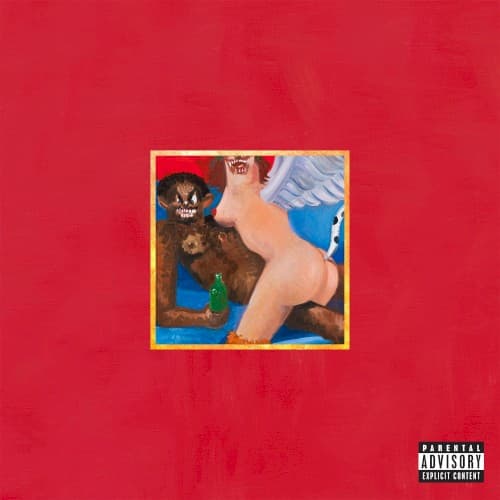
Over the following days Condo produced eight or nine paintings, five of which shipped as official, interchangeable covers. Art direction sat with West himself alongside fashion designer Virgil Abloh, while Condo held the brush. The five are commonly identified as a ballerina, the naked sphinx straddling West, a crowned severed head run through by a sword, a cubist close-up portrait of West with mismatched eyes and four sets of teeth, and a work called The Priest. The ballerina began when Condo's wife Anna showed West a slow-motion clip of French dancer Sylvie Guillem; West asked for a great ballerina painting, and Condo imagined one mid-toast, a second, dyspeptic ballerina among the set. The 'Head with a sword' was used for the 'Power' single after West said he liked the Shakespearian thing, and Condo linked its forging of cubism and classicism to the layered styles in the music.
Condo said he was challenging West with the sphinx image, and that West replied, 'I'm shocked, but I like it, and I gotta go with my gut feeling.' By Condo's telling, West had asked specifically for an image provocative enough to be rejected by retailers as a deliberate publicity stunt, and told him he wanted a phoenix.