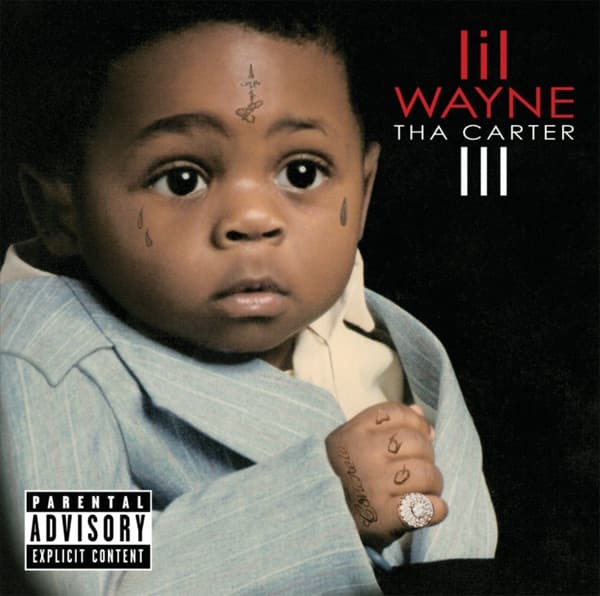
A baby, no older than a toddler, stares straight into the lens with an expression too solemn for his age, set against a background so black it seems to swallow everything but him. He wears a powder-blue pinstriped suit with a cream shirt, one tiny fist curled against his chest. It should be the most innocent picture in the world. Then you notice the ink.
There are teardrops running from both eyes, a small cross tattooed above his brow, and letters scrawled across the knuckles of that little clenched hand. On an infant, it reads as absurd, unsettling, and funny all at once, which is exactly the collision that makes the cover of Tha Carter III impossible to look away from.
The baby is Dwayne Carter, the future Lil Wayne, and the photo is genuinely his: a childhood snapshot he handpicked himself. Behind the camera, decades earlier, was Mrs. Carter, his own mother, credited here as the photographer. What she captured was an ordinary dressed-up portrait of her son. What arrived on record store shelves in 2008 was that same boy with an adult's hard-earned tattoos grafted onto his soft face.
The hand doing the grafting belonged to Scott Sandler, known as Mr. Scott, who served as both art director and designer on the project. Tasked with drafting the cover, he pitched a whole range of concepts, and the tattooed-baby idea was one he assumed would be thrown out. Rap at that moment, as he saw it, was very serious, and nobody had much of a sense of humor. The image was his attempt to inject some. To his surprise, it was the one that stuck. Sandy Brummels is credited with creative direction over the release.
Sandler's digital work is the whole trick. Wayne's real tattoos never dated back to childhood, obviously; they were added to the picture, the adult face and neck markings masked onto the baby. The seams are part of the fun. The face is unmistakably a child's, round-cheeked and wide-eyed, yet it carries the vocabulary of a grown man who has lived hard: the teardrops, the cross, the script on the fingers. It invites the exact question people kept asking, namely how anyone got tattoos onto a baby Lil Wayne.
The humor has ancestors, and Sandler knew it. The concept nods openly to the childhood-photo covers of Nas' Illmatic and The Notorious B.I.G.'s Ready to Die, two records that put innocent young faces on the front of very grown, very unforgiving music. Tha Carter III takes that lineage and twists it, keeping the baby but tagging him with the evidence of the life to come. The innocence and the ink argue with each other on the same face.
The layout keeps things spare so the photograph can do the work. On the right side, the title stacks in clean sans-serif: "lil" in white, "WAYNE" in red, "THA CARTER" in white beneath, and a large red "III" anchoring the corner. The red pulls the eye toward the name, then releases it back to those staring eyes. In the lower-left corner sits the black-and-white Parental Advisory Explicit Content label, a small badge of the grown reality lurking behind the baby picture.
Composition-wise, the boy fills most of the frame, cropped from the chest up and lit so his face and suit glow against the darkness. There is nothing else to look at, no scenery, no props beyond the suit, which forces you into that face and its contradictions. The single raised fist, with its inked fingers, doubles as both a baby's natural gesture and a subtle echo of an adult pose.
What began as a gag Sandler expected to be discarded turned into one of the highest-stakes releases of its year. Tha Carter III arrived on June 10, 2008, on Cash Money Records, and sold 1,005,545 copies in its first week in the United States, going on to become the highest-selling album of 2008 in the country. It won the Grammy for Best Rap Album and carried hits including "Lollipop," "A Milli," "Mrs. Officer," and the Grammy-nominated "Mr. Carter." The joke, it turned out, was on anyone who thought a tattooed baby couldn't sell a million records in seven days.
The image outlived the moment. That handpicked childhood photo has since reappeared on three more of Wayne's records, most recently Tha Carter VI in 2025, turning a one-off concept into a running signature across his discography. For the album's tenth anniversary, Spotify enlisted current rappers, among them Lil Uzi Vert, to recreate the cover, restaging the tattooed-baby pose all over again. What Sandler assumed would land in the trash became the face his artist returns to, decade after decade, still staring out with those solemn, impossible eyes.