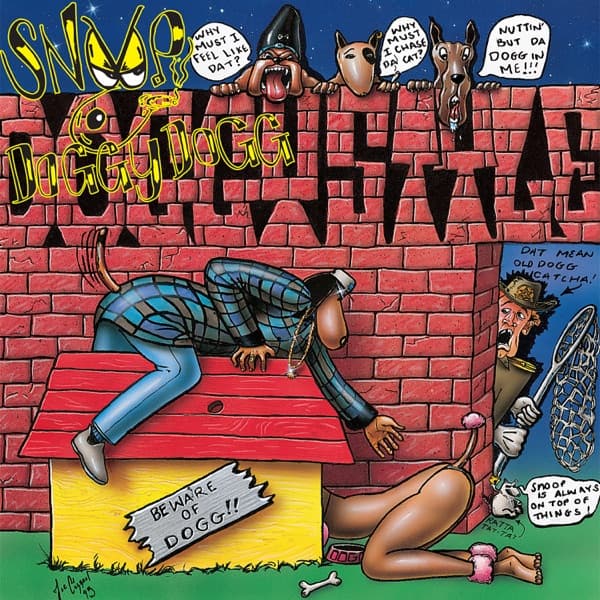
Look at the doghouse first. A cartoon character in a plaid shirt, baggy blue jeans and sneakers is sprawled belly-down across its red roof, arm and one leg dangling off the sides, diving headlong toward the dark opening below. A hand-lettered sign nailed to the front warns BEWARE OF DOGG!! A bone lies in the grass. And crawling into that little house on hands and knees is a curvy female figure with a dog's tail and pink cuffs, drawn cheeky and explicit, her rear the visual punchline the whole composition leans toward.
Behind them rises a red brick wall, and peering over its top are three dogs, each with a thought bubble: "WHY MUST I FEEL LIKE DAT?", "WHY MUST I CHASE DA CATS?", "NUTTIN' BUT DA DOGG IN ME!!!" Off to the right, a scowling dogcatcher in a safari hat pokes through a doorway clutching a net, muttering "DAT MEAN OLD DOGG CATCATCHA!" A tiny mouse squeaks "SNOOP IS ALWAYS ON TOP OF THINGS," while another caption reads "GATTA TA-TA!" The whole frame crackles with jokes stacked on jokes.
Overhead, against a midnight-blue starred sky, the name Snoop Doggy Dogg sprawls in jagged yellow graffiti letters, the two dots of the eyes narrowed like a cartoon villain's. Below it, DOGGYSTYLE stretches enormous across the brick, its outlined block letters doubling as the wall's headline. Every inch is filled. Nothing is subtle.
The man behind it all was Darryl "Joe Cool" Daniel, Snoop's older cousin, the one he and Daz Dillinger had always called Joe Cool. In the early 1990s Daniel had come out of prison and kicked a crack addiction, and it was right after that his cousin phoned him to draw the cover of his debut, produced by Dr. Dre.
The concept came secondhand. Snoop relayed what Dre wanted: "Dr. Dre really wants a picture of me on top of a doghouse, reaching over, feeling on a dog's ass or something. But I want you to draw it, though." That last part was the license. Snoop wanted the idea filtered through his cousin's own hand and humor, and Daniel obliged, layering in all those thought bubbles and side jokes that turn a single crude gag into a busy comic-strip world.
The scene had a real-life staging behind it. Daniel had his then-girlfriend pose on his mother's couch as reference, and that pose is what the doghouse tableau and the female dog crawling inside are drawn from. He signed the work under the name "Joe Cizzool." "I didn't think it would be iconic, man," he later said, still sounding disbelieving that a sketch built from a couch pose and family jokes would follow him for decades.
Snoop has traced the cartoon-dog look back to Too Short's "Short Dog's in the House," and you can feel that lineage in the choice to render West Coast menace as kid-show cartooning. That was the trick and the provocation: Daniel took a medium built for children and loaded it with adult content, and in 1993 that collision grabbed eyes exactly because it wasn't supposed to be there.
Released on November 23, 1993, through Death Row and Interscope, Doggystyle was the record that cemented G-funk's grip on hip-hop, a West Coast gangsta rap album whose sound felt like sunshine over menace. The cover became its face, and not everyone wanted to look. The art was condemned as lascivious, and it did nothing to soften civil rights activist C. Delores Tucker in her campaign against gangsta rap.
Things escalated past reviews. In 1994 the inner sleeve artwork was carried into a Washington D.C. hearing on Commerce, Competitiveness, and Consumer Protection, entered as evidence before a subcommittee where the art and music were condemned as obscene and degrading to women. A drawing that started on a mother's couch ended up as an exhibit in Congress.
Critics piled on too. Q's Danny Kelly sniffed that the sleeve "competes with The Waterboys' Dream Harder and Billy Joel's River of Dreams as the worst attached to a recent release," and Robert Christgau slapped the album with a "dud" rating. But the outrage was rocket fuel. The congressional hearings only raised Snoop's profile and pushed sales higher, proof that a BEWARE sign draws more people than it warns off.
Daniel kept building the brand he'd accidentally launched. He drew the artwork for the "Gin and Juice" single and later the cover for The Last Meal, extending the cartoon universe he'd sketched here. That hand-drawn, comic-panel aesthetic, jokes in the margins and menace under the fur, rippled through rap cover art for years after, an entire visual language born from a cousin fresh out of jail being told to draw it his own way. Look again at that dog diving into the doghouse, and you're looking at the moment cartoons in hip-hop grew teeth.