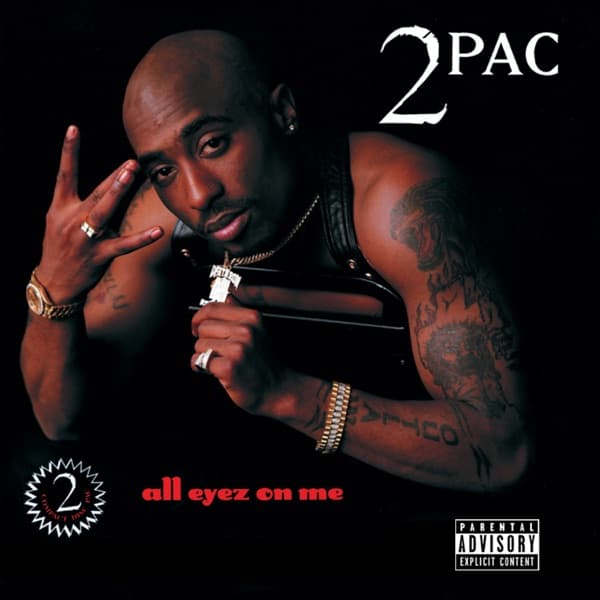
Against a background of absolute black, 2Pac leans into the frame, bald head catching a soft light, two fingers raised to his temple in a gesture that reads as both a peace sign and a challenge. His gaze is level, unhurried, fixed directly on whoever is holding the record. Nothing else competes for that first glance. The darkness swallows everything but skin, gold, and ink.
Then the details arrive. He wears a black leather vest, open, and beneath it his chest and arms are a map of tattoos. A large piece sprawls across one shoulder and bicep, another crawls up his forearm, and lettering runs along the opposite arm. On his wrists sit two gold bracelets, one a heavy watch, the other a chain-link band, and rings glint on his raised fingers. A pendant hangs at his throat. The styling is deliberate and loud: this is a portrait built to project wealth, defiance, and stillness all at once.
The typography plays the same game of contrast. In the top right, "2PAC" is stamped in tall white capitals with a rough, brushed texture, as if painted fast and left to dry. Down in the lower left, the title All Eyez on Me sits in small red lowercase script, almost a whisper against the shout of the name. Beside it is a circular emblem, a starburst badge with a "2" at its center, and in the bottom corner the familiar black-and-white Parental Advisory sticker for explicit content. The composition leaves most of the cover empty and black, which only sharpens the focus on the man and his unbroken stare.
That title, and that look, carry a weight the image could not have known. Released on February 13, 1996, this was the fourth studio album by 2Pac, and it would be the last one to come out while he was alive. Seven months after it reached stores, he was murdered in a drive-by shooting. The cover's cool, watchful gaze reads differently once you know that the eyes on him were about to become the eyes of history.
The album arrived through Death Row Records and Interscope Records, with distribution handled by PolyGram. It holds a peculiar distinction: it was the only Death Row and Interscope release pushed through PolyGram in the US, a one-off arrangement that set it apart from everything around it in the label's catalog. Even the business machinery behind the record was singular.
As a double album, it stretched out into what critics described as a lush G-funk sound layered over gangsta rap, the low, warm, synth-heavy groove that defined West Coast hip-hop in that era. The scale of it matched the ambition of the image on the front: nothing modest, nothing restrained, a man filling the frame and a record filling two discs.
It was supposed to arrive earlier. The plan pointed toward a Christmas 1995 release, but the date kept slipping as 2Pac kept recording and shooting music videos, unwilling to stop feeding the project. The delay pushed it into February, and the sprawling body of work that resulted became part of the reason it loomed so large.
The numbers eventually caught up to the myth. In 2014 the album was certified Diamond by the RIAA, its shipments passing five million copies, with each disc of the double album counted separately toward that total. Decades after that unblinking portrait was shot, the record kept moving, kept selling, kept being discovered.
Recognition came in waves, some of it while grief was still fresh. The album won the 1997 Soul Train Music Award for Rap Album of the Year, awarded posthumously, and it was nominated for Best Rap Album at the 39th Grammy Awards that same year, also posthumously. The man staring out from the black background was gone before the honors arrived, which lends the whole thing the strange quality of a monument built after the fact.
The critical afterlife kept growing too. In 2020, All Eyez on Me landed at number 436 on Rolling Stone's updated list of the 500 Greatest Albums of All Time, a placement that confirmed the record had outlasted its own moment and become a fixed point in the culture. The cover, with its blunt confrontation and its single sentence of a title, had turned into shorthand for an entire chapter of hip-hop.
Look back at the image one more time and the title becomes almost unbearable in its precision. All Eyez on Me: a man alone in the dark, jewelry gleaming, tattoos on display, fingers raised, refusing to look away. It is a portrait of someone who understood exactly how much attention was fixed on him, and chose to meet it head on. The black around him has never filled in with anything else. He is still there, still staring, still daring you to hold the gaze.