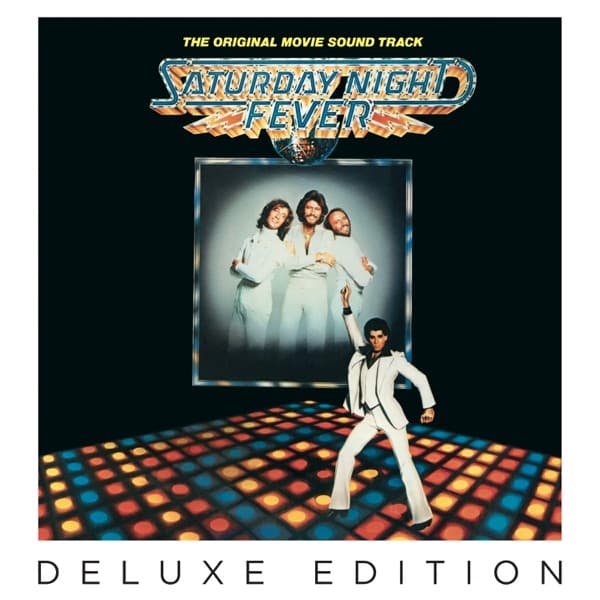
Look at where your eye lands first: the raised right arm, index finger pointed skyward, the whole body torqued into a diagonal that cuts across the lower half of the frame. John Travolta, dressed head to toe in a cream-white three-piece suit with a black shirt open at the collar, plants one foot forward and throws his weight into a pose that needs no caption. This is Tony Manero, the character he plays in the 1977 film, caught in the disco-dancing move that would become shorthand for an entire era.
He is standing on light. The floor beneath him is a grid of illuminated squares glowing in hot reds, ambers, oranges and cool blues, the classic lit dance floor receding toward the back of the frame. The colors bleed and shimmer where they meet, giving the whole surface a molten look, as though Travolta is balanced on a bed of coals that refuse to burn him. The high contrast between his pale suit and the saturated floor makes the figure pop off the cover with almost cut-out sharpness.
Rise up from his pointing finger and you meet the second image: a framed photograph mounted like a window on the black background behind him. Inside it stand the three brothers of the Bee Gees, also in white, gathered close together, hair long, expressions calm. Above their heads a mirror ball hangs and scatters points of reflected light. The composition stacks the story neatly, dancer below, music-makers above, the men who supplied the sound floating over the man who moved to it.
At the top, the title arrives in chrome. Saturday Night Fever is set in a bold, faceted logo, its letters catching orange and blue highlights so they read like polished metal under club lighting. Riding just above it in small red capitals is the line THE ORIGINAL MOVIE SOUND TRACK, a plain-spoken label doing quiet work: this is not a Bee Gees album, it is a various-artists collection tied to a movie. Along the bottom, the words DELUXE EDITION sit in clean white type against the black border, marking this particular reissue.
The film itself, distributed by Paramount Pictures and directed by John Badham, gave the cover its central image straight from the screen. The dancing pose is lifted from the movie, a still turned into a marketing icon, and it works because it compresses the entire premise into one gesture. You do not need to have seen the film to understand the promise: put this record on, and you too might command a floor like that.
RSO Records issued it on November 15, 1977, as a double LP, the jacket built around that large image of Travolta with the film's imagery and the Bee Gees carried through the packaging. The copyright line reads 1977 RSO Records, Inc., the label that manufactured and marketed it. In an era of concept-heavy gatefolds and painted fantasy, this cover made a different bet: real photography, a real actor, a real dance move, no illustration required.
The bet paid off on a scale almost no one had seen. Saturday Night Fever became the best-selling album in music history up to that point, moving more than 40 million copies before Thriller eventually overtook it. In the United States it was certified 16 times Platinum, and it held the top of the charts for 24 straight weeks, nearly half a year of dominance. The white suit, the raised arm, the glowing floor: they were traveling into tens of millions of homes.
Part of why the cover endures is its economy. There is no clutter, no busy collage, no crowd of extras. The black background swallows everything except the three things that matter, the dancer, the framed band, the metallic title. That emptiness gives the figure room to breathe and makes the pose feel monumental rather than casual. Your eye has nowhere else to go but the man in white and the light he stands on.
There is a deliberate doubling in the palette too. Travolta and the Bee Gees are all dressed in white, a rhyme that ties the human elements together against the darkness, while the only riot of color is the floor and the chrome lettering. Warmth lives at the bottom, in the reds and oranges of the tiles; coolness sits above, in the blue glints of the logo and the mirror ball's scatter. The composition reads from bottom to top like a rising temperature, heat of the dance below, the source of the music floating serenely overhead.
What makes it linger is the freeze. Dance is motion, yet here it is stopped dead, one arm up, one hip cocked, everything held. The still image dares you to imagine the movement that came before and after, the beat that put him there. That tension between frozen frame and implied rhythm is the whole trick of the cover, and it is why a single movie photograph could carry a double album to the top of the world and hold it there for months. The record inside sold the seventies; the picture on the front still points straight up, finger toward the light, refusing to come down.