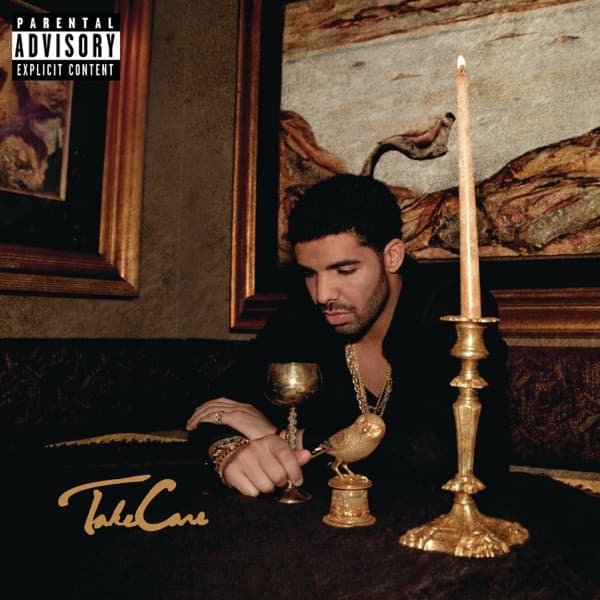
The candle flame is the brightest thing in the frame, and it's tilting slightly, as if the room has a draught nobody has fixed. Everything else glows a slow, burnished gold: the enormous brass candlestick, a small golden bird perched on the table, a ceremonial chalice, and the chains pooled across a bare chest. In the middle of all that treasure, a young man sits with his head bowed, eyes down, one hand loosely curled around the cup. He does not look like a man celebrating. He looks like a man doing accounting.
This is the cover of Take Care, Drake's album, released on November 15, 2011 through Young Money Entertainment, Cash Money Records and Republic Records. The photograph is the work of Jonathan Mannion, and it was made inside Joso's, one of Drake's favorite restaurants in Toronto. Knowing the setting reframes everything you see. This isn't a fantasy palace built on a soundstage. It's a real dining room, with a heavy gilt-framed painting behind him and dark upholstered walls, dressed up until it reads like a throne room.
The eye lands first on that flame, then slides down the tall candlestick to the table, where the real drama is quietly staged. Drake wears an open black shirt with nothing underneath but several chains, layered and heavy, and a pinkie ring catching the light on his left hand. His forearm rests on the tablecloth, wrist encircled by a bracelet, fingers barely holding the stem of the golden chalice. He is staring into it. Whatever is or isn't inside that cup, he's looking for an answer there.
The small golden bird between him and the candle is easy to miss and hard to forget once you notice it. Read as an owl, it becomes an emblem, a little sentinel keeping watch over the whole tableau of money and ceremony. It sits perched on its own stand, facing outward, while the man beside it looks away and down. The composition sets them against each other: the object stares at us, the human refuses to.
Drake explained the image plainly to MTV News. It shows the kid who went from his mom's basement in Toronto to, in his words, becoming a king. That single sentence carries the entire tension of the picture. The gold, the chalice, the crown-implied throne of a restaurant chair: these are the trappings of arrival. The bowed head and the mournful stare are the reminder that arrival is complicated.
He was candid about the ambivalence. The lifestyle on display, the clubs and the money and the women, was one he had thrown himself into. But he said he did not intend to let it consume him. You can see that argument playing out on the cover itself. The wealth is arranged around him like an offering, close enough to touch, and he touches only the cup, and even that gently, without conviction. The posture reads as a man weighing the thing in his hands rather than raising it in triumph.
Mannion's lighting does a lot of the emotional work. The single practical candle motivates a warm, low glow that leaves the edges of the frame in shadow and lets the gold objects do the shining. There's very little cool color anywhere. The painting behind him dissolves into amber and brown, so the whole scene feels sealed inside a warm, private box. It's intimate and slightly claustrophobic, a room you can't quite see the exits of.
The typography is deliberately restrained against all that opulence. Down in the lower left, Take Care is set in a slim, cursive gold script, lowercase and elegant, almost a signature. It doesn't shout the title so much as sign the mood. In the top left corner sits the black-and-white Parental Advisory box, the only hard-edged, high-contrast element in an image otherwise built entirely from soft light and warm metal. That small rectangle of stark rules is a jarring reminder that this dreamlike scene is also a commercial product with a content warning stamped on it.
Take Care landed as pop rap and contemporary R&B, and the cover previews that hybrid before a single note plays. There's the swagger of hip-hop wealth in the chains and the gold, and there's the introspective ache of R&B in the downcast eyes and the solitary setting. The picture holds both at once, which is exactly what the music inside tries to do. It's a portrait of success photographed as a mood rather than a boast.
The image has kept its pull for years, to the point that fans still make the trip to Joso's to sit at the table and recreate it. That afterlife tells you something about why it works. A more literal luxury shoot, a mansion or a club, would have aged into a period cliché. Instead Mannion gave us a single figure in a real restaurant, surrounded by symbols and refusing to look up, and left the meaning open enough that anyone who has ever gotten what they wanted and felt strange about it can slide into that chair.
So the candle keeps burning at the top of the frame, the little gold bird keeps watch, and the king keeps staring into his cup. The cover never resolves the question it poses. That refusal is the point, and it's why the picture still stops you before the music even starts.