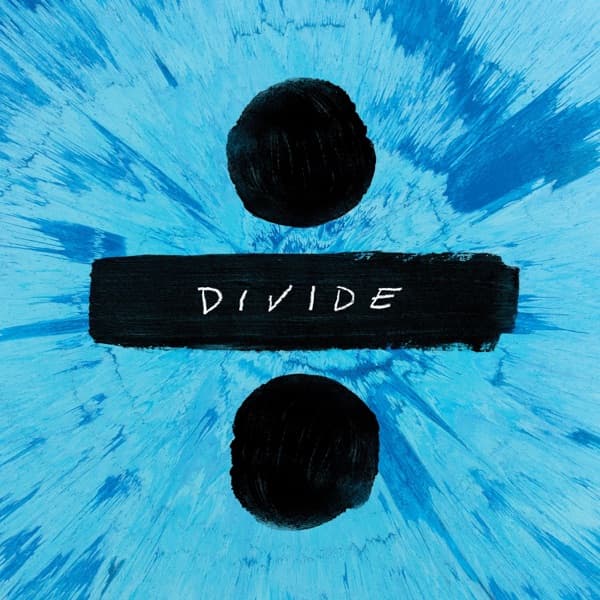
The cover of ÷ (Divide) began with a piece of artwork made by Ed Sheeran himself, not with a commissioned photograph or a painting supplied by a famous artist. Adult Art Club founder Jonny Costello, who led the album's visual campaign, said Sheeran created the large blue spin painting that became the front sleeve.
Atlantic Records had approached Adult Art Club after seeing the studio's earlier work. The brief was deliberately open, but two parts of Sheeran's existing visual system had to remain: the mathematical-symbol naming sequence established by + and ×, and a strong album-specific color. The previous record had been green; for ÷, the team was asked to work around blue.
According to Costello, Sheeran made the spin painting using a machine at Damien Hirst's studio with Hirst's permission. That is an important distinction. Hirst provided access to the equipment; the album's original cover painting is credited to Sheeran. Costello recalled that Sheeran made two versions, each roughly seven feet square, and the design team chose the one that translated best to the sleeve.
The scale of the original created another problem: reproducing all of its detail. Costello said the team brought in the head of photography at Birmingham Museum and Art Gallery and used a digital-backed medium-format camera. The release credits identify David Rowan specifically for cover-art photography. Rowan's professional work for Birmingham Museums further supports that connection. His job was not to invent the image but to photograph Sheeran's physical painting with enough fidelity for print and digital reproduction.
The finished sleeve was then shaped by Adult Art Club. The original package credits Jonny Costello and Charlotte Audery with art direction and design. Costello described the typography as a collaboration with Charlotte, while Korean fashion illustrator Kasiq Jungwoo supplied the more detailed watercolor-style illustrations used across the project. Costello also created a contrasting set of rougher track illustrations.
That makes the front cover a collaboration with unusually clear stages: Sheeran made the painting; Rowan photographed it; Costello and Audery designed and art-directed the sleeve. The simple white division symbol over the blue radial painting is the final compression of that process, turning a seven-foot handmade object into an image that works at the size of a vinyl jacket, a CD and a phone screen.
The sleeve also continued a visual language rather than starting from zero. + had established the mathematical naming idea, × carried it forward, and ÷ kept the system recognizable while changing the dominant color. Adult Art Club's job was therefore partly one of continuity: make the third record unmistakably Ed Sheeran while giving it a visual identity strong enough to stand on its own.
The cover's apparent simplicity can hide how many people were involved. The most accurate answer to 'who made the Divide cover?' is not a single name. Ed Sheeran created the original painting; David Rowan made the cover-art photograph; Jonny Costello and Charlotte Audery of Adult Art Club handled design and art direction.