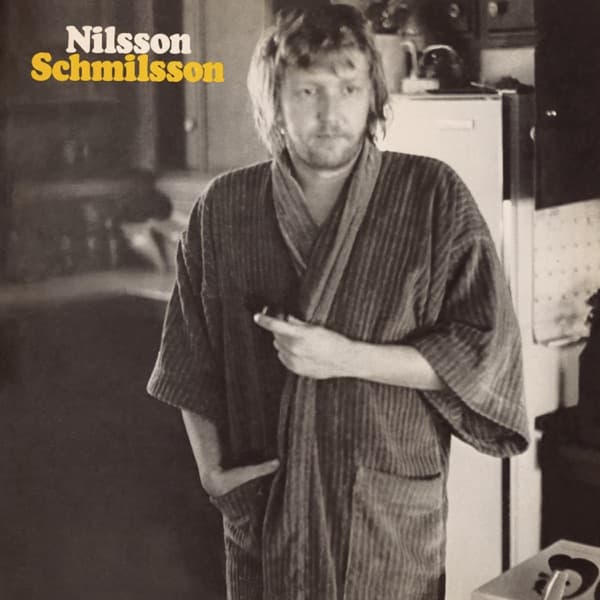

The first thing you notice is how ordinary it all looks. No stage, no spotlight, no glamour. Just a man in a striped bathrobe standing in a kitchen, his shoulders slightly slumped, staring back at the lens with the heavy-lidded gaze of someone who has not yet finished waking up. This is the cover of Nilsson Schmilsson, and it may be the least rock-and-roll image a rock singer ever put on a jacket.
The photograph is soft, a little out of focus, printed in warm sepia tones that make the whole scene feel like a snapshot fished out of a shoebox. Harry Nilsson fills the center of the frame, his shaggy hair falling past his ears, a scruff of beard shadowing his jaw. The robe hangs open at the chest, cinched loosely at the waist, one hand tucked near a pocket. In the other hand he holds a pipe, raised almost to his chest, as if he has been interrupted mid-thought.
Look past him and the domestic details assemble themselves. To the right stands a refrigerator, its rounded white door catching the light. Cabinets recede into the soft-focus background on the left. On the floor in the lower corner sits what appears to be the edge of a record player or turntable, a small nod to the machine that will spin the very album you are holding.
The title does the rest of the work. In the top-left corner, in a friendly rounded yellow typeface, sit two words: Nilsson stacked over Schmilsson. The joke is old and Yiddish, the sing-song way of dismissing a name by echoing it back with a mocking "schm" prefix. Applied to himself, it reads as pure self-deprecation. Here is a serious record wearing a punchline for a title, and the man on the cover dressed to match.
That mismatch was the point. Harry Nilsson had built his early reputation on a polished pop-star look, and this image threw it out with the coffee grounds. The once-clean-cut singer had grown his hair long, let his face go unshaven, and let himself be photographed in his bathrobe. Everything about the picture is un-glamorous, an intentional shrug in the direction of anyone expecting a matinee idol.
The man behind the camera was Dean Torrence, better known as the Dean of the surf-pop duo Jan and Dean. Off the microphone, Torrence built a second career in cover art, and he made images for several Nilsson albums. There is something fitting about one pop performer photographing another in his kitchen rather than a studio, capturing him as a friend might, rumpled and unposed.
The pipe in his hand has become part of the album's lore. Described as a hashpipe, it lends the sleepy, disheveled scene an extra layer of meaning, the domestic ease reading less like a lazy Sunday and more like a private ritual. Whether read as innocent or knowing, it deepens the sense that this is a man entirely off-duty, refusing to perform.
And yet the music inside was anything but half-asleep. Released on November 11, 1971, on RCA Records, the album marked a turn in Nilsson's work. Under producer Richard Perry, he shed his quirkiest pop inclinations and made a rock-and-roll band record, settling comfortably into a pop and rock singer-songwriter idiom. The bathrobe casualness of the cover disguised a tightening of ambition.
That ambition paid off. Nilsson Schmilsson became his most commercially successful work, yielding three of his best-known songs. Chief among them was "Without You," a shattering ballad that climbed all the way to number 1. The gap between the joke title, the kitchen snapshot, and the towering emotion of that single is one of the great deadpan tricks in album packaging.
The recognition kept coming. The album performed well at the 1973 Grammy Awards, earning a nomination for Album of the Year, an honor that seems almost comic next to the cover's studied refusal to look important. A man in a robe with a pipe, and the industry's biggest prize on the table.
That is the lasting charm of this jacket. It bets everything on anti-glamour, trusting that the songs will carry the weight while the image plays it cool. The blur, the sepia, the fridge, the bathrobe, the sly two-word title in soft yellow letters: every choice pushes against the idea of the polished star. Decades on, it still works precisely because it dares you not to take it seriously, and then hands you "Without You."