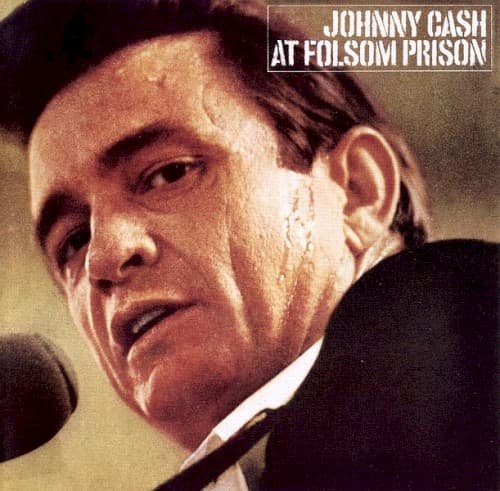
The first thing to correct against the image itself: this is not a neutral monochrome. The whole frame is washed in a warm amber-to-sepia range, dark chocolate in the shadows warming to a burnt honey across the lit planes of the face. That tonal choice does something specific to the eye: it reads as heat and age at once, closer to old lamplight or nicotine than to the cool grey of a documentary photograph. The color is not decorative; it makes the picture feel like something remembered under artificial light rather than something recorded, which suits a portrait that wants to feel confessional rather than clinical.
The composition is built on a strong diagonal. Cash's head is tilted, the jaw dropping toward the lower left, so the face is not squared to the viewer but canted, as if caught mid-turn or mid-word. That tilt keeps the image from settling into a static mugshot; the eye enters at the bright upper forehead, slides down the ridge of the nose and the shadowed cheek, and is carried off the lower-left edge. The head is cropped hard at the top and at both sides, so the skull runs out of frame. He is too big for the space he occupies, which reads as pressure, a man pushed right up against the surface of the picture with nowhere to recede.
Light falls from the upper left and rakes across the face, so every plane is described by shadow: the socket of the eye, the crease from nose to mouth, the slack of the lower lip. The lighting is hard enough to catch the shine of moisture on the forehead and temple, small specular highlights that turn the skin into something worked and used rather than posed. Because the light is so directional, the far side of the face falls into deep shadow, and the portrait becomes half-lit, one side legible and one side withheld. That split does real interpretive work: the man is only partly given to us.
The lower right quadrant is almost pure darkness, the black bulk of his shoulder and jacket, and at the bottom edge a paler wedge of shirt and collar catches the light. In the lower left sits a dark, blunt shape that reads as a microphone or its stand, a soft silhouette rather than a described object. It anchors the picture in performance without illustrating it: the tool of the voice is present but pushed to the margin and rendered as a shadow, so the emphasis stays on the man and not the act.
The negative space is nearly all in the upper right corner, and that is where the type lives. The title, set in a plain bold sans-serif capital, is boxed inside a thin ruled rectangle floated in the one patch of open, mid-toned ground. Two lines: the name, then the place. The box is small relative to the head, and it sits at the opposite corner from the darkest mass, balancing the composition like a counterweight. The lettering has no serifs, no styling, no ornament; it announces and steps back. Set against the raked warmth of the skin, the clean white caps read almost like a label pasted onto a photograph, an administrative caption for a human document.
The technique is straight photographic portraiture with minimal intervention: no montage, no drawn elements, no border framing the image, so the photograph bleeds to all four edges and the type is the only graphic incursion. That decision matters. By letting the picture run edge to edge and refusing any design furniture, the cover insists that the photograph is the whole content, that nothing needs to be added to or arranged around the face.
What the whole thing says is carried by the gaze and its direction. Cash is not looking at us. His eyes are cast down and slightly to the side, heavy-lidded, the brow drawn. Combined with the downward tilt of the head and the open, unsmiling mouth, the expression sits between exhaustion and reckoning, a man caught in a private moment rather than presenting one. The picture withholds the direct address that most star portraits offer, and that withholding is the argument: this is not a face selling itself but a face absorbed in something heavier. The warmth of the tone, the sweat, the half-shadow and the marginal microphone all point the same way, toward a portrait that treats a performer as a laboring, sweating, thinking human under hot light, and lets that one head, too large for its frame, stand in for everything the record contains.