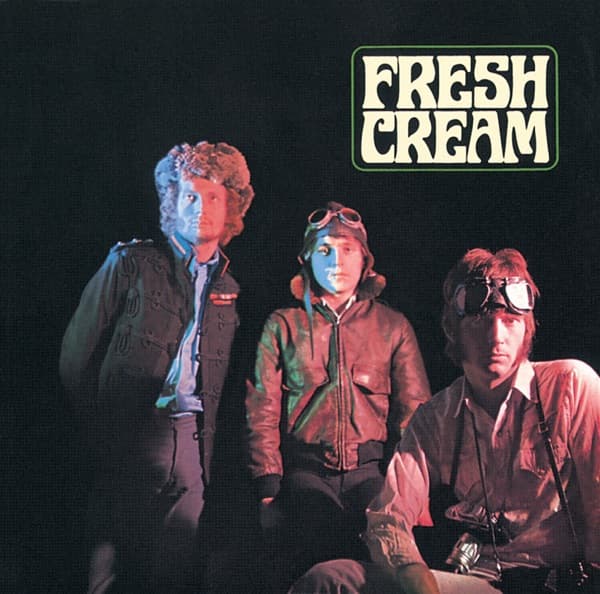
Three faces float out of pure black, and the first thing your eye does is try to place the light. It refuses to make sense. The man on the left is bathed in a cold electric blue, his hair a frizzy halo, his eyes narrowed under the brim of some kind of Davey Crockett raccoon type cap. The figure in the middle is caught in a green-and-blue chill, sporting a fur-lined flight collar, a leather aviator's helmet strapped tight to his head. The man on the right sits lower, closer, warmer, his skin flushed red and his goggles pushed up onto his forehead, watching you with a flat, unbothered stare. Nothing behind them. No room, no horizon. Just darkness and these three, dressed for a war that never quite arrives.
This is Fresh Cream, released in the UK on 9 December 1966, and it announces a band with the swagger to skip the pleasantries. The clothing is a costume box raid on military aviation: brass-buttoned tunics, bomber jackets, goggles and flying helmets. It reads less like a document of who these men are and more like a staged tableau, three players posed as some ragtag squadron. The colored lighting, blue on one, green on the next, red on the last, splits them into separate emotional temperatures even as they share the same black frame. The effect is theatrical and slightly eerie, faces sculpted by gels rather than daylight.
Up in the top right corner sits the only bright, friendly thing on the sleeve: the words Fresh Cream in fat, bulging, cream-white letters, boxed and outlined in green. The typography has a swollen, almost inflated quality, the kind of rounded lettering that would soon flood the psychedelic era. It glows against the dark like a sign switched on in an empty street, pulling your gaze up and away from the three watchful figures before sending it back down to them again.
The design carries the credit of Paragon Publicity and Public Relations Ltd. of London, a firm handling the look of a debut that would matter far more than a first outing usually does. There is no illustration here, no painting, no collage. It is a straight photograph, and its power comes entirely from restraint: darkness, three subjects, colored light, one word repeated. The confidence to leave that much empty space is itself a statement.
Fresh Cream was the first LP on Reaction Records, the label owned by producer Robert Stigwood. Launching a new imprint with an unproven group is a gamble, and the cover behaves like one made by people certain of what they had. There is no attempt to sell softness or accessibility. The men do not smile. They look, if anything, a little cold and a little dangerous, which suited a band whose music was about to hit heavier than almost anything around it.
Because what these three were doing inside the sleeve reshaped the ground under rock. Fresh Cream turned out to be a pivotal record in blues rock, and instrumental in the birth of both jam rock and heavy metal. Cream stretched the blues until it snapped into something louder and freer, weaving through blues rock, psychedelia, and hard rock, giving each player room to push and improvise. The aviator theme almost fits in hindsight: three musicians strapping in for flights nobody had charted yet.
The physical object was built with real care. The UK sleeve was laminated on the front, printing that full-color photograph with its lurid blues and reds in a glossy finish, while the back flipped to something plainer: an unlaminated black-and-white half-tone. That production was printed and made by Ernest J. Day & Co. Ltd. of London. The contrast between a shiny, saturated front and a matte monochrome back gave the package two moods, the theatrical face and the workmanlike reverse.
As the album crossed borders, the lettering shifted with it. When Atco Records issued it in the US in January 1967, in slightly different form, the band name arrived in different typography from the UK sleeve. The German Polydor pressing went further still, using yet another typeface, this one with strangely elongated lower halves to the letters. The same three faces in the same black void, but the word floating above them kept being redrawn, each territory giving the group its own signature.
The American release did more than change fonts. That Atco edition climbed to number 39 on the US charts, carrying this British debut into a market that would soon embrace the band completely. The photograph, with its squadron of moody young aviators, became the introduction millions got to a group that barely existed a year earlier.
Decades on, the standing of the music behind the sleeve was affirmed when Rolling Stone placed Fresh Cream at number 102 on its 2012 list of the 500 Greatest Albums of All Time. Look again at the cover with that in mind and the staging reads differently. The three men in their borrowed uniforms, lit in impossible colors and set adrift in the dark, are not playing dress-up so much as posing for a moment they seem to know will last. The eye keeps returning to that red-lit face on the right, goggles up, gaze steady, as if daring you to put the record on. That was always the point.